
Diaper Elastic Strands: Leg, Cuff and Waist Counts Explained

On September 1, 2026
Comments Off on Diaper Elastic Strands: Leg, Cuff and Waist Counts Explained
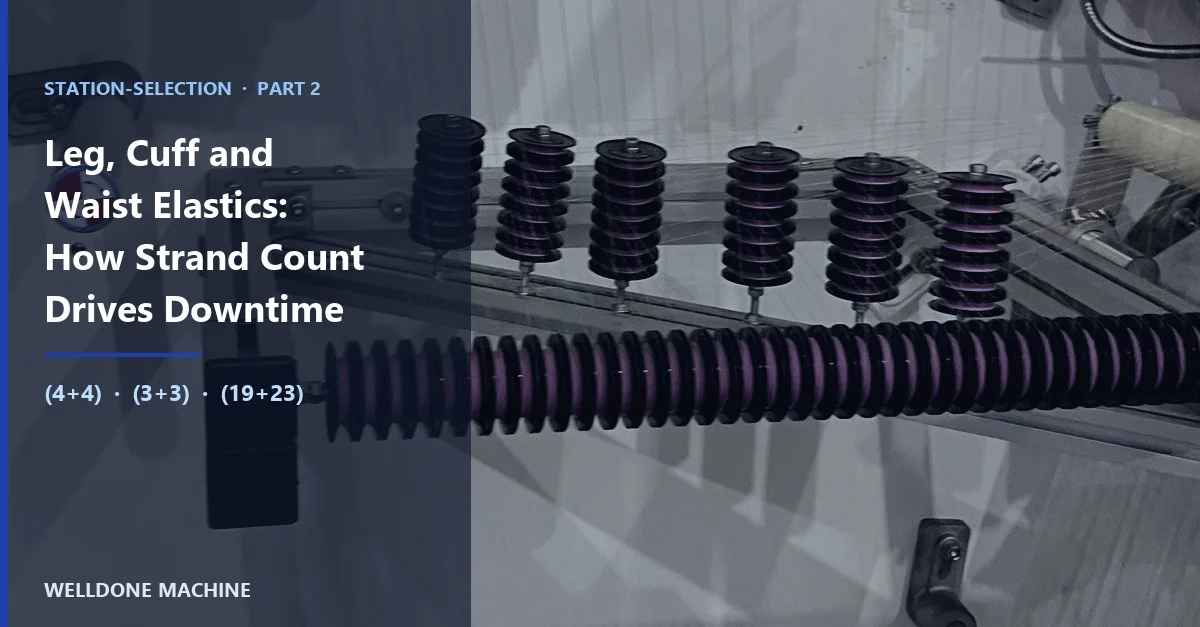
Diaper Elastic Strands: How Leg, Cuff and Waist Counts Drive Downtime
A baby diaper machine specification will list elastic positions as short bracketed numbers. Cuff elastic (4+4). Leg elastic (3+3). Waist spandex (19+23). They look like minor line items next to the forming drum and the packing section.
They are not minor. Those brackets add up to the number of continuous threads your line must keep under constant tension for an entire shift. Every one of them is a thread that can run out, snap, or drift. This article explains what the counts actually commit you to.
Station-Selection Series · Part 2
Part 1: Diaper Forming Drum vs Block Demoulding — how the demoulding method locks in your SKU count and tooling cost.
Part 2 — this article: the elastic stations, strand counts, and why splicing is the quiet driver of unplanned stops.
Part 1: Diaper Forming Drum vs Block Demoulding — how the demoulding method locks in your SKU count and tooling cost.
Part 2 — this article: the elastic stations, strand counts, and why splicing is the quiet driver of unplanned stops.
Three elastic stations, three different jobs
Open a full servo I-shape configuration document and the elastic work is split across separate sections. It is worth understanding why they are separated, because buyers frequently treat "elastic" as one line item during quotation comparison.
The WD-NK800I-SV configuration sheet lists them under two headings. Section B covers the leakage stations: Cuff Elastic (4+4) and Leg Elastic (3+3). Section D covers the waistband, where the entry reads Waist Spandex (19+23). Section A offers a fourth option, Float Core with Spandex (1+1), applied at the top sheet.
Each serves a distinct containment function. Leg elastics gather the product around the thigh. Cuff elastics raise the standing barrier that sits inside the leg opening. Waist spandex creates the stretch band that holds the diaper in place when the baby moves. Different jobs, different tension requirements, different failure signatures.
| Station (config section) | Strand notation | Total continuous threads | Containment function |
|---|---|---|---|
| Top sheet float core (A4) | Spandex (1+1) | 2 | Shapes the hourglass core profile |
| Cuff elastic (B1) | (4+4) | 8 | Raises the standing leakage barrier |
| Leg elastic (B2) | (3+3) | 6 | Gathers the product at the thigh |
| Waist spandex (D2) | (19+23) | 42 | Elastic waistband stretch and hold |
Source note: strand notations are quoted directly from the WD-NK800I-SV configuration document (sections A4, B1, B2, D2). Counts vary by product design and are confirmed per project — treat the figures above as one worked configuration, not a universal standard.
What the strand count actually controls
Add the leakage stations together and a single I-shape product carries 14 continuous elastic threads before the waistband is even considered. Add the big waistband configuration and the number reaches 56.
Fifty-six threads, each unwinding from its own spool, each needing consistent tension from the first metre to the last. That is the real content of those bracketed numbers.
The connection to output is direct. A thread that breaks does not produce a slightly worse diaper. It produces a product with a missing gather on one side, which the vision system flags as waste, and the operator has to stop the line to re-thread. The re-thread itself is quick. Finding which of the 56 spools failed, at line speed, is not.
Every bracket in the elastic section is a thread that can stop your line.
The splice problem nobody quotes for
Spandex arrives on spools. Spools run out. When one does, the operator must join the tail of the old spool to the head of the new one, and the machine cannot wait indefinitely for that to happen.
On a manual line, this is a stop. The operator halts the section, makes the joint, re-tensions, and restarts. On a line running at the WD-NK800I-SV stable speed of 600 ppm for L size, a four-minute manual splice costs roughly 2,400 pieces of production. Do that six times a shift across different spools and the arithmetic gets uncomfortable.
Actually, the more damaging part is not the lost minutes. It is the restart. A line that stops and restarts has to re-establish tension across every web simultaneously, and the first products after a restart are frequently out of specification. The waste attributable to a splice is the stop plus the ramp, not the stop alone.
Auto splicing: what the option really buys
The configuration document lists an optional item that addresses exactly this. Item 13 reads Lycra Auto Splicing System — 90° Feeding, described as "Auto Splicing function for Leg and Cuff Spandex: For 10 pcs Spandex," priced at 8,000 USD.
Read that scope carefully, because it is the part buyers skip. The system covers 10 pieces of spandex, and it is specified for the leg and cuff stations. The leakage stations in this configuration total 14 strands. The waistband adds 42 more.
| Coverage question | What the configuration document states | Practical consequence |
|---|---|---|
| Which stations are covered | Leg and Cuff Spandex | Waistband spandex is outside the stated scope |
| How many strands | For 10 pcs Spandex | Cuff (4+4) plus leg (3+3) is 14 strands in this build |
| Included or optional | Optional, 8,000 USD | Not present unless explicitly ordered |
| Effect on acceptance | Passing rate clause excludes Auto Splicing | Splice performance sits outside the 97% figure |
None of this makes the option a poor purchase. It makes it a scoped purchase. The right conversation at quotation stage is which strands the system will cover in your product structure, and what happens at the strands it does not reach.
The real question is not whether to buy auto splicing. It is whether the quotation you are comparing includes it at all — because two quotations that look 8,000 USD apart may simply differ on this one line.
The tension window, and why servo matters here
Spandex is bought pre-stretched and applied under tension. Too little tension and the gather is weak, so the product leaks at the leg. Too much and the strand snaps, or the non-woven puckers and the diaper looks defective on the shelf.
That window is narrower than most buyers expect, and it moves during the run. As a spool depletes, its effective diameter shrinks, and a drive that holds constant rotational speed will progressively under-feed. Full servo control lets the system sense that change and compensate continuously. Without it, the last portion of a spool is where tension drift concentrates.
The configuration sheet is explicit that this is a whole-line property, not a station feature: item 1 states "All positions, including raw materials unwinding, are servo control." Unwinding is named specifically because that is where elastic tension originates.
Speed, and the clause attached to it
The WD-NK800I-SV performance block lists a designed speed of 315 m/min and a stable speed of 600 ppm at L size, 300 m/min. Annual volume is given as 40–140 million pieces.
The passing rate line is the one to read twice. It states ≥ 97%, followed by a parenthetical: "Not include the glue applicator, Auto Splicing."
In most cases buyers read the 97% and move on. The exclusion is doing real work in that sentence — it says glue application and splicing performance are measured separately from the headline efficiency figure. Both are elastic-adjacent systems. Both are exactly where elastic-related waste appears.
| Acceptance parameter | Value in the RFS test table | Note |
|---|---|---|
| Product | I-Shape Baby Diaper | Tested at the seller's plant before shipment |
| Duration | 30 minutes | Longer runs are chargeable to the buyer |
| Selected size | Large / MAXI | Single size, not a multi-size run |
| Test speed | 300 meters/min | Matches the stable speed, not the designed speed |
| Minimum efficiency | 85% | Acceptance threshold for the test window |
| Maximum waste | 3% | Ceiling for the same 30-minute window |
Two figures worth clarifying with your supplier. The performance block quotes a passing rate of ≥ 97%, while the RFS acceptance table sets minimum efficiency at 85% over a 30-minute run. These describe different things — a steady-state target versus a short-window acceptance floor — but they are easy to confuse when comparing offers. Ask which figure the contract is written against, and over what duration.
A misconception worth correcting
There is a widespread belief that more elastic strands mean a better product. More gathers, better containment, higher perceived quality on the shelf. The logic is reasonable, and it is not entirely wrong.
In practice the relationship is conditional. Strand count contributes to containment only when tension is uniform across every strand. Fourteen leakage strands with two running loose perform worse than eight strands all correctly tensioned, because the uneven ones create a channel rather than a barrier.
More importantly, each added strand adds a spool, a splice interval, and a failure point. The specification decision is not "how many strands can this machine apply." It is "how many strands can my team keep uniformly tensioned across a full shift." Those are different questions, and the second one depends on your operators, not on the machine.
Why Welldone
Manufacturer, not a trading intermediary
Welldone has built hygiene product machinery for more than 18 years from Jinjiang, Fujian. Elastic application is one of the areas where configuration detail decides whether a line runs cleanly — so we put the strand counts, the splicing scope, and the acceptance parameters in the configuration document rather than leaving them to be discovered during commissioning.
- Full servo control across all positions, including raw material unwinding
- Elastic strand counts specified per station in the configuration sheet
- Auto splicing scope stated explicitly, including which stations it covers
- RFS acceptance test witnessed by the buyer's representative before shipment
Configuration first
Product structure options are selected before the drawing is fixed, so the elastic stations match the product you intend to sell.
Scope stated in writing
Optional systems list what they cover. Auto splicing is documented by station and strand count, not described as a general feature.
Acceptance before shipment
The RFS test runs at the seller's plant with the buyer's representative present, against written speed, efficiency and waste parameters.
Related machines
I-Shape Elastic Waistband Line
Full servo I-shape baby diaper line. Design speed 800 pcs/min, stable
600 pcs/min.
Learn more
I-Shape Big Waistband Machine
Big waistband I-shape configuration, the structure behind the (19+23) waist
spandex arrangement.
Learn more
T-Shape Baby Diaper Machine
Full servo T-shape line. Design speed 600 pcs/min, stable 450–550
pcs/min.
Learn more
Pull-Up Baby Diaper Line
Pull-up construction, where waist elastic behaviour differs from taped
products.
Learn more
Pull-Up Adult Diaper Machine
Adult incontinence line. Design speed 300 pcs/min, stable 250 pcs/min.
Learn more
3-Piece Baby Pants Machine
Three-piece pants construction for baby pull-up products.
Learn more
Conclusion
The elastic sections of a specification are short. Four brackets, a handful of numbers, one optional line item at 8,000 USD. They are also the sections that decide how many times your line stops during a shift, and how much product the restarts cost you.
Before you sign, count the strands in your own product structure. Then ask which of them the auto splicing system will actually reach, and what the plan is for the rest.
If your line stopped four extra times next shift because a spandex spool ran out at the wrong moment, what would that cost in product, in restart waste, and in the operator time spent finding which spool it was?
Frequently asked questions
What does the notation (4+4) mean on an elastic station?
It describes the strand count applied on each side of the product — four on the left, four on the right, eight continuous threads in total for that station. Leg elastic at (3+3) means six threads, and waist spandex at (19+23) means 42.
Does the auto splicing system cover every elastic strand?
Not automatically. In the WD-NK800I-SV configuration the optional Lycra Auto Splicing System is specified for leg and cuff spandex, for 10 pieces of spandex. Confirm the covered stations and strand count against your own product structure before ordering.
Why is the passing rate quoted with exclusions?
The configuration document states a passing rate of at least 97%, excluding the glue applicator and auto splicing. Those systems are measured separately, so their performance should be discussed as its own item during technical clarification.
How does strand count relate to the forming station choice?
They are separate decisions that interact through changeover time. The demoulding method sets how much tooling a size change needs, as covered in Part 1 of this series, while strand count sets how much re-threading and re-tensioning that changeover involves.
Can strand counts be changed after the machine is built?
Changes are possible in some cases but depend on the applicator design and the space available at each station. It is treated as an engineering change rather than a setting, so it is far cheaper to resolve during configuration. Discuss the intended product range with the engineering team through our technical enquiry page before the drawing is fixed.
Written by: Welldone Machine Engineering Team
Technical review: Mostafa Ansary, Technical Sales Manager — BSc
Mechanical Design and Production Management, Cairo University; 15 years in production
management and machinery
Market context: Tidiane Thiero, International Sales Engineer —
electrical engineer, Huaqiao University Xiamen; 3 years in the hygiene industry,
covering line planning and raw material specification
Welldone Machine Co., Limited has
manufactured hygiene product machinery from Jinjiang, Fujian for more than 18 years.
Discuss your elastic configuration
Send us your product structure and we will map the strand counts, splicing scope and acceptance parameters against it before any drawing is issued.
Website: www.cnwelldone.com
Email: welldone@cnwelldone.com