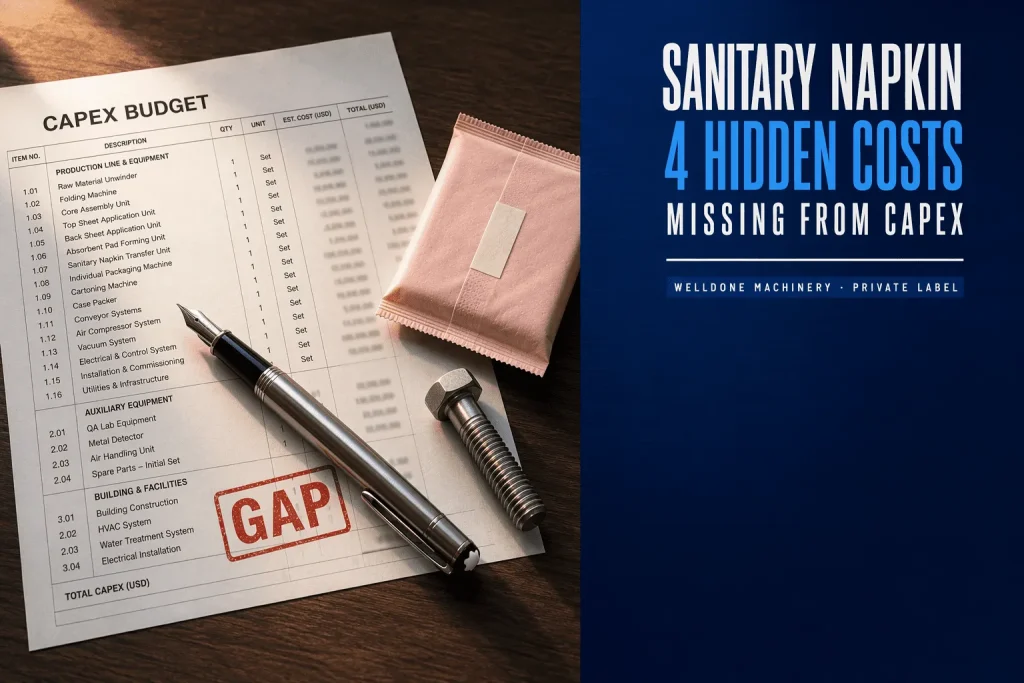
Top 8 Hidden Costs Buyers Miss When Buying a Sanitary Napkin Production Line

On May 26, 2026
Comments Off on Top 8 Hidden Costs Buyers Miss When Buying a Sanitary Napkin Production Line
Welldone Top Insights Series
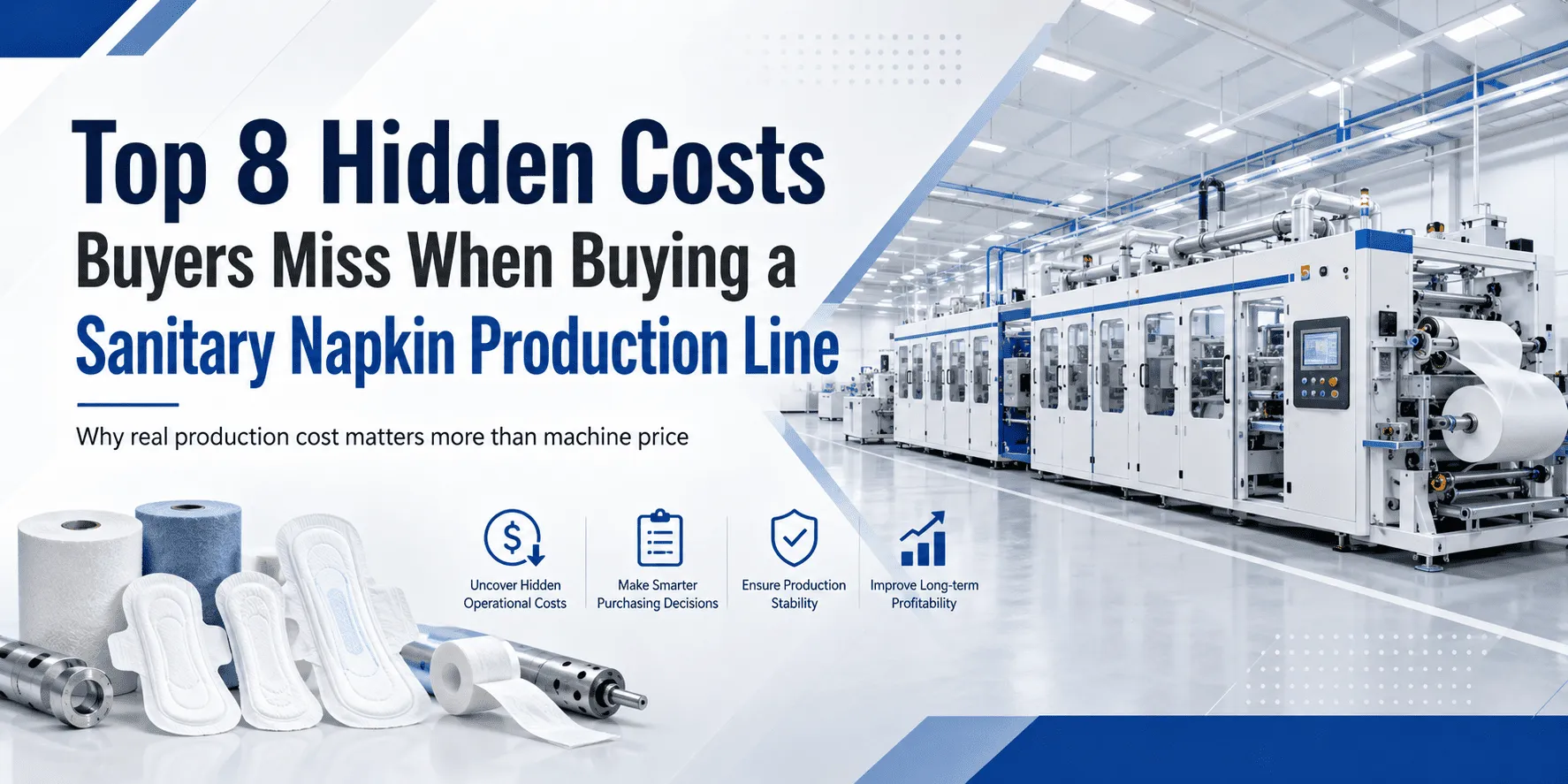
Top 8 Hidden Costs Buyers Miss When Buying a Sanitary Napkin Production Line
A practical buying guide for factory owners, procurement teams, and investors who want to understand the real production cost behind machine price, stable output, and long-term factory operation.
Machine price vs. real production cost
Material waste and glue stability
Operator training and changeover loss
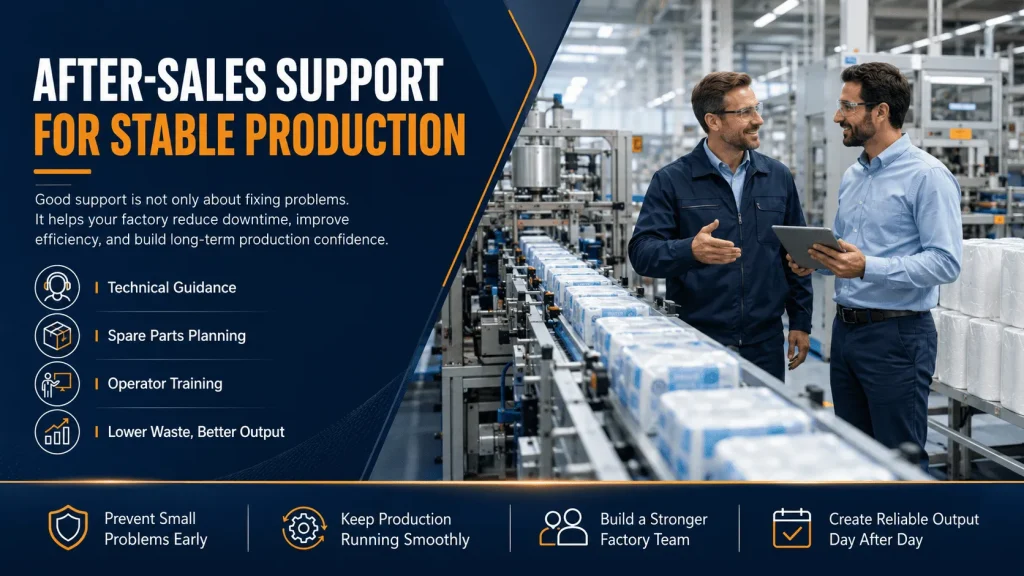
Engineer support and spare parts planning
8
Hidden costs that can affect sanitary pad factory profit, production stability, and long-term investment results.
Why Machine Price Is Not the Full Cost
When buyers compare a Sanitary Napkin Production Line, the first focus is often the quotation.
Machine price. Design speed. Delivery time. Payment terms.
These points are important. But they are only the visible part of the investment.
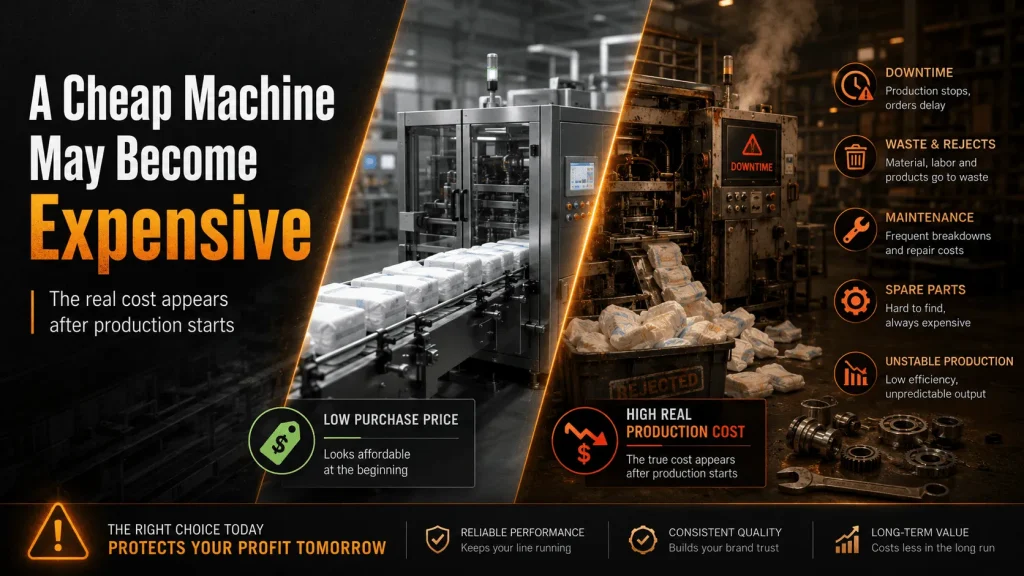
After the machine enters the factory, another cost list starts to appear: material waste, glue cleaning time, operator training, spare parts waiting time, product size changeover, packing bottlenecks, unstable qualified product rate, and engineer support when the line cannot run smoothly.
The real question is not only “How much is the Sanitary Pad Making Machine?” but “What will this machine cost my factory after it starts running every day?”
Actually, these hidden costs often decide whether a Sanitary Napkin Machine becomes a profitable investment or a daily production headache.
i
Market Context
This topic matters more in today’s market. For sanitary pad factories, when nonwoven, PE film, release paper, pulp, SAP, hot melt adhesive, packaging materials, logistics schedules, and labor training become harder to manage, every production mistake becomes more visible.
01
Material Waste During Adjustment
Material waste usually appears before stable production begins. During machine testing, product size adjustment, tension balancing, glue position correction, core forming adjustment, and packaging alignment, the factory may consume a large amount of material before the line reaches a stable condition.
- Nonwoven fabric
- PE film
- Release paper
- Fluff pulp and SAP
- Hot melt adhesive
- Packaging film
02
Unstable Glue Application
Glue application looks like a small technical detail, but it can create serious hidden costs. In sanitary napkin production, hot melt adhesive affects bonding strength, pad shape, surface cleanliness, wing position, release paper attachment, and user comfort.
- Glue stringing
- Poor bonding
- Dirty machine parts
- Frequent cleaning
- Unstable wing position
- Higher rejection rate
03
Poor Material Tension Control
A Sanitary Napkin Machine works with several different materials at the same time. Each material has different thickness, elasticity, strength, and surface behavior.
If material tension is not controlled well, production may face web deviation, poor lamination, unstable product shape, uneven cutting, poor wing positioning, wrinkled surface material, and higher rejected product rate.
04
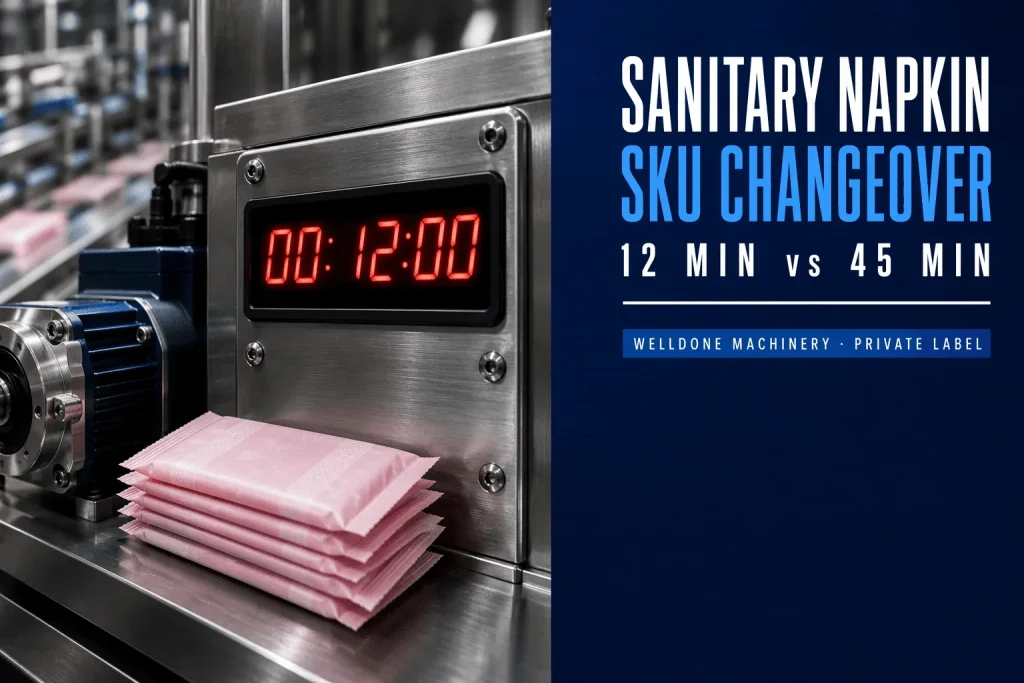
Slow Size Changeover
Many sanitary napkin factories do not produce only one product. They may need to produce day-use pads, night-use pads, winged sanitary pads, ultra-thin pads, panty liners, different lengths, and customized private-label products.
If changeover is slow, the factory loses production time. If adjustment after changeover is unstable, the factory also loses materials.
05
Low Qualified Product Rate
A sanitary napkin factory does not make money from total output only. It makes money from qualified output. If a Sanitary Napkin Production Line produces many pads but the rejection rate is high, the factory may still lose profit.
- Unstable core forming
- Poor cutting accuracy
- Glue deviation
- Wing position error
- Material wrinkle
- Packing deformation
06
Operator Training and Night Shift Mistakes
Many buyers think machine installation means production is ready. But installation is only the beginning.
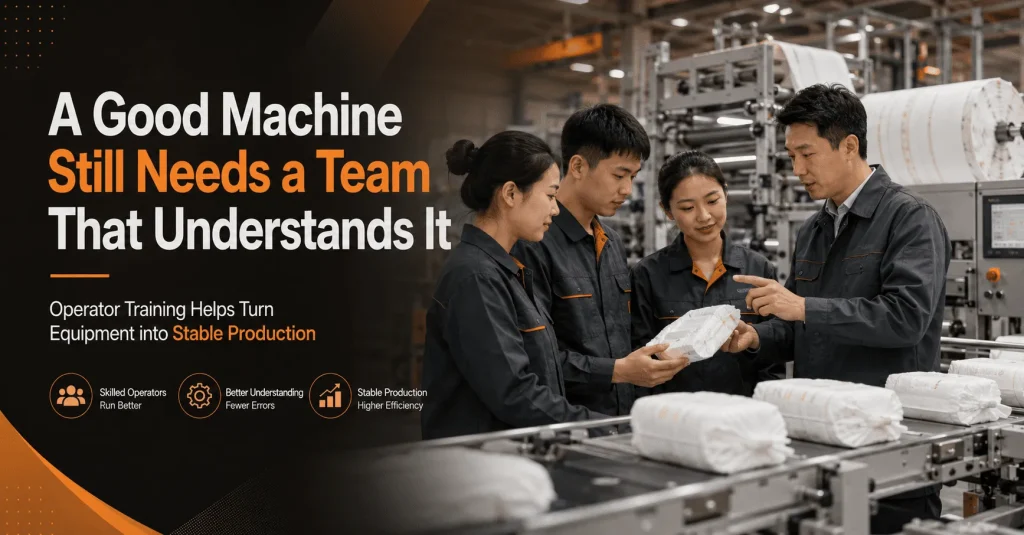
Operators need to understand material loading, HMI operation, start-up process, glue system management, alarm handling, tension adjustment, mold changeover, quality inspection, daily cleaning, and basic troubleshooting.
Night shift mistakes are another hidden cost. One wrong adjustment can create material waste for hours.
07
Spare Parts Delay
Every production line needs spare parts. Even a high-quality Sanitary Pad Making Machine needs regular maintenance and replacement of wearing parts.
If spare parts are not planned in advance, a small component problem may stop production for days. The machine may stop because of one small part, but the business impact can be much larger.
08
Weak After-Sales Engineer Support
A sanitary napkin production line is not a simple machine purchase. It is a complete production project.
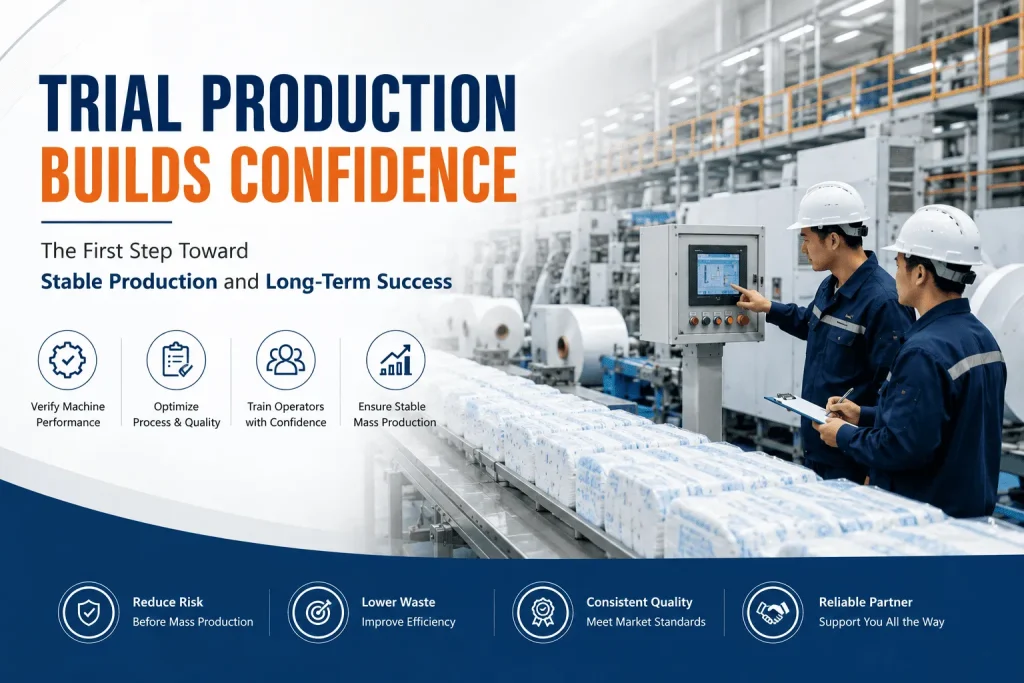
Buyers need installation, commissioning, product testing, raw material adjustment, operator training, quality improvement, and long-term troubleshooting.
This is why choosing the right Sanitary Pad Machine Supplier matters.
The Better Buying Question
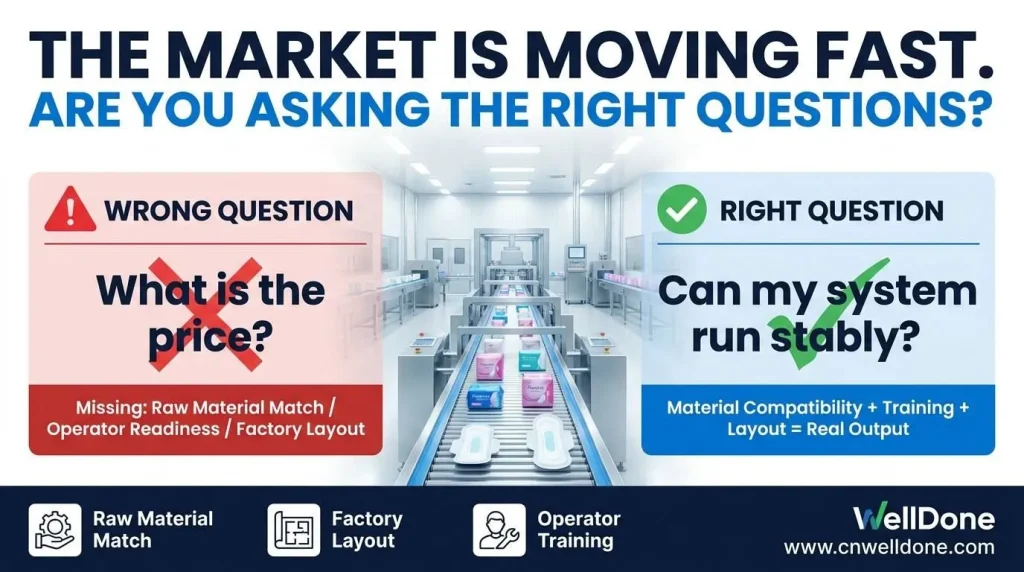
Before buying a Sanitary Pad Manufacturing Machine, do not only ask: “How much is the machine?”
Ask a more practical question: “Can this production line help my factory run stably, control waste, train operators, and keep qualified output every day?”
Controlled material waste
Stable qualified output
Practical operator training
Long-term engineer support
Why Welldone
Welldone is a hygiene products machinery manufacturer under Quanzhou Shimao Weiteng Import & Export Co., Ltd. With more than 18 years of industry experience and our own factory support, Welldone provides Sanitary Napkin Machines, Sanitary Pad Making Machines, baby diaper machines, adult diaper machines, underpad machines, pet pad machines, wet wipes machines, tissue machines, and related hygiene product production solutions.
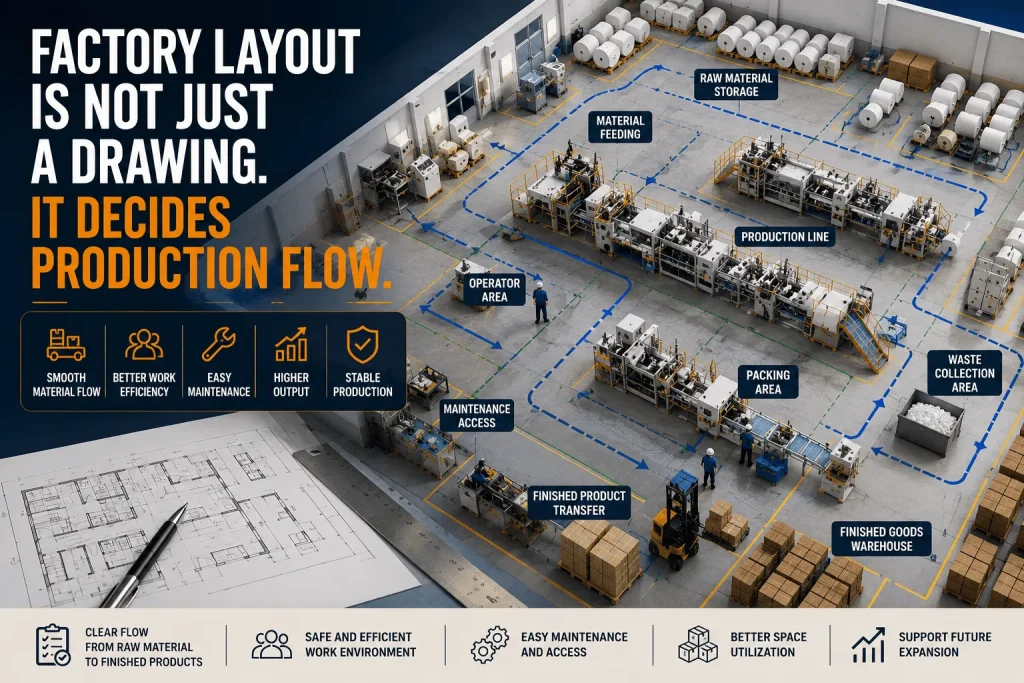
For female care projects, Welldone can support buyers with full servo and semi servo sanitary pad machine options, sanitary napkin product structure customization, winged pad and panty liner machine solutions, raw material matching suggestions, factory layout planning support, installation and commissioning guidance, free outbound engineer support, spare parts, and one-stop solutions from machine to raw materials.
If you are evaluating a Sanitary Napkin Machine Manufacturer, you can also explore Welldone’s Female Care Machines for different feminine care production solutions.
Welldone is not a distributor or wholesaler. We are a manufacturer focused on helping buyers build stable, long-term hygiene product production capacity.
Related Machines
Sanitary Pad Machine
Suitable for producing standard sanitary pads, winged pads, ultra-thin pads, and customized feminine hygiene products.
Sanitary Napkin Production Line
Suitable for factories planning stable and continuous production of feminine care products for local markets or OEM orders.
Panty Liner Machine
Suitable for producing light absorbent feminine care products with stable lamination and precise forming.
Menstruation Pant Making Machine
Suitable for buyers developing higher-value feminine care products and body-fit absorbent pants.
Bar-Type Winged Pad Machine
Suitable for customized winged sanitary pads and different market product structures.
Female Care Packing Machine
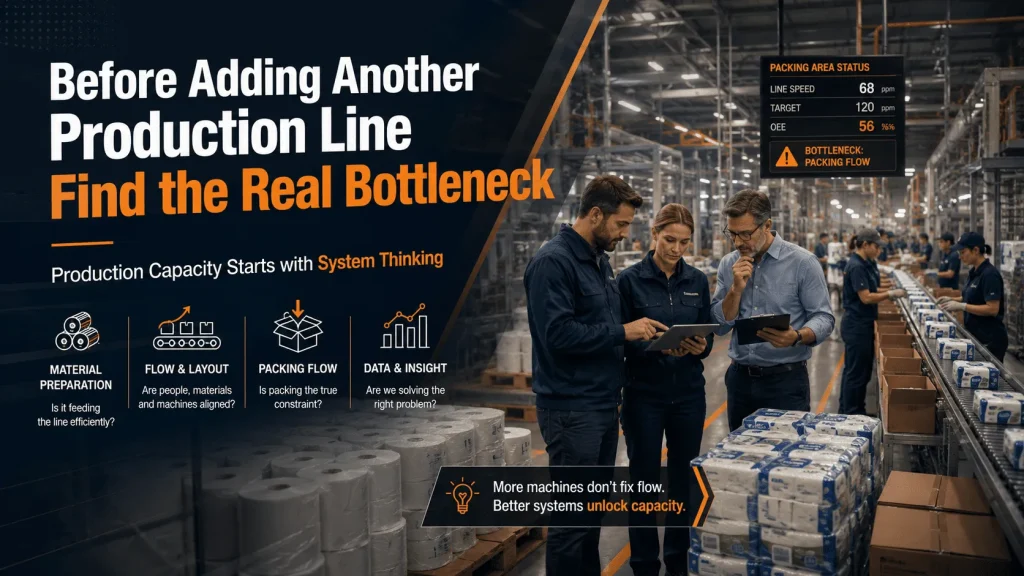
Suitable for improving packing efficiency and reducing bottlenecks between production and final packaging.
Conclusion
The visible cost of a Sanitary Napkin Production Line is the quotation. The real cost appears after the machine starts running.
Material waste, glue cleaning, tension instability, slow changeover, low qualified product rate, operator mistakes, spare parts delay, and weak engineer support can all change the real investment result.
Before buying a Sanitary Napkin Machine, buyers should not only ask: “How much is the machine?”
They should ask: “Can this production line help my factory run stably, control waste, train operators, and keep qualified output every day?”
FAQ
1. What hidden costs should buyers consider before buying a sanitary napkin production line?
Buyers should consider material waste, glue cleaning time, operator training, product size changeover, spare parts delay, low qualified product rate, packing bottlenecks, and engineer support.
2. Is machine price the most important factor when buying a sanitary napkin machine?
No. Machine price is important, but stable production, waste control, qualified product rate, operator training, and after-sales support often have a bigger impact on long-term factory profit.
3. Why does glue application matter in sanitary pad production?
Glue application affects bonding strength, product appearance, wing position, user comfort, machine cleanliness, and rejection rate. Unstable glue performance can create high hidden costs.
4. How does raw material quality affect a sanitary pad making machine?
Raw materials such as nonwoven, PE film, release paper, pulp, SAP, and adhesive directly affect tension stability, core forming, cutting accuracy, bonding quality, and final product consistency.
5. Can Welldone support a complete feminine care factory project?
Yes. Welldone can provide sanitary napkin machines, panty liner machines, female care packing machines, raw material planning suggestions, factory layout advice, installation guidance, engineer support, spare parts, and one-stop production solutions.
Planning a Sanitary Napkin Production Project?
If you are comparing a Sanitary Napkin Production Line, Sanitary Napkin Machine, or Sanitary Pad Making Machine, Welldone can help you evaluate machine configuration, raw materials, factory layout, and long-term production support.