Trial Production for Hygiene Product Machines: From First Good Sample to Stable Mass Production

On June 29, 2026
Comments Off on Trial Production for Hygiene Product Machines: From First Good Sample to Stable Mass Production
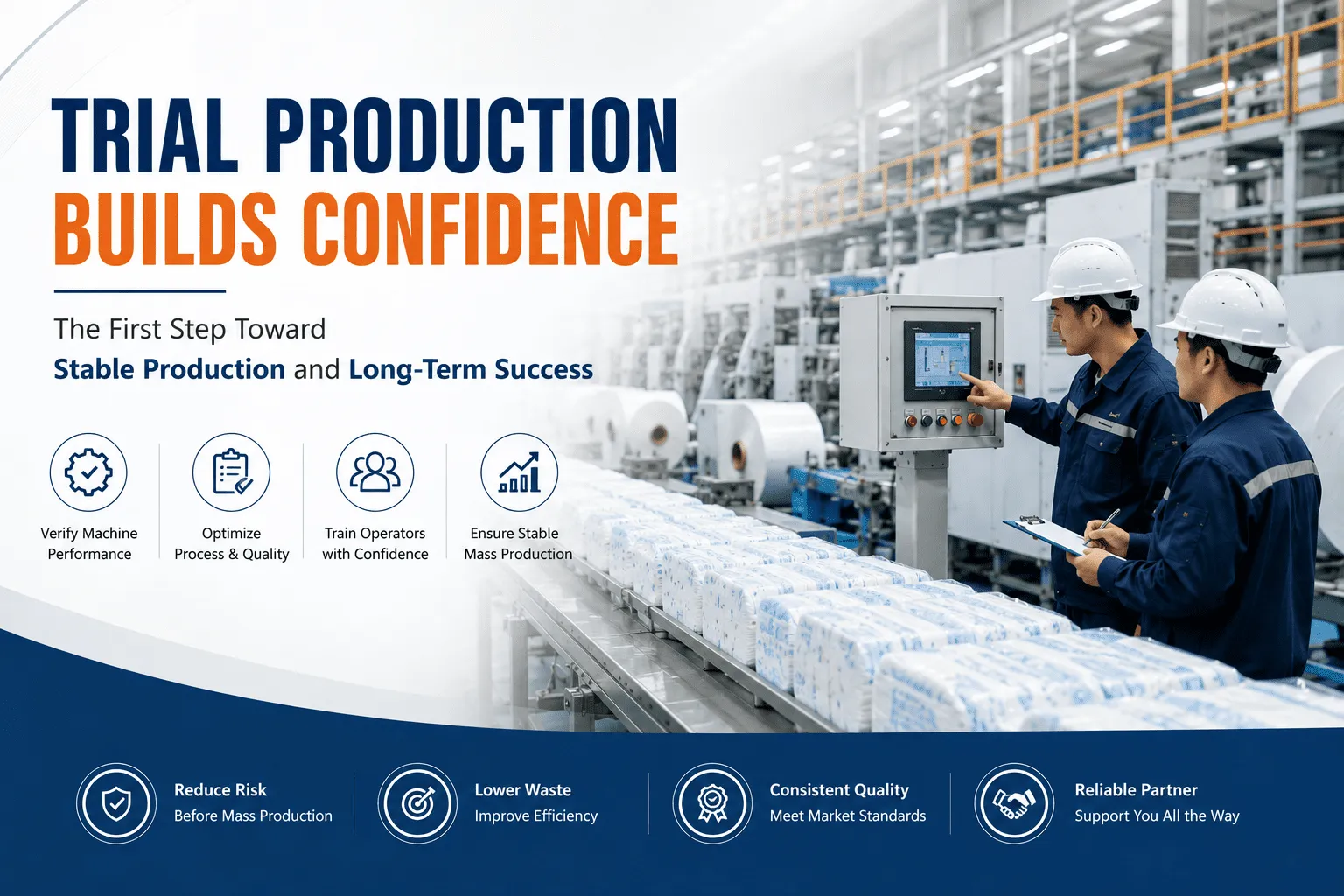
Trial Production Guide
The First Good Sample Is Not the Finish Line: Why Trial Production Decides Stable Mass Production
A good sample proves that the machine can produce the product under certain conditions. Stable mass production proves that the factory can keep producing qualified products every day. These are two very different things.
```
```
Why the First Good Sample Can Be Misleading
In many hygiene product machine projects, there is always one exciting moment.
The machine starts running. The first finished products come out. The sample looks good. The buyer, engineers, and factory team finally feel relieved.
For a new factory owner, this moment is important. It means the machine has been installed. It means the product can be made. It means the project has moved from drawings, discussions, and shipping documents into real production.
But for a factory that wants long-term business, the first good sample is not the finish line. It is only the beginning.
A good sample proves that the machine can produce the product under certain conditions. Stable mass production proves that the factory can keep producing qualified products every day.
During the first test, many conditions are controlled. Engineers are usually on-site. Operators are watching closely. Materials are prepared in advance. The machine speed may be moderate. Everyone is focused on one goal: getting the product out correctly.
Under this condition, it is possible to make a good sample.
But daily production is different. In real production, the factory may need to run for many hours. Operators may need to work in shifts. Raw materials may come from different batches. Product sizes may change. Packing workers may need to keep up with the line. Quality inspection must continue during production. Small machine issues must be solved quickly.
This is where the real challenge begins.
One sample is a milestone, not a guarantee.
Trial production should prove whether the factory can produce the same product stably, repeatedly, and profitably.
What Trial Production Should Really Prove
Trial production should never be treated as a simple demonstration. It should be treated as the first serious test before mass production.
A good trial production process should prove several things at the same time.
Machine Stability
The machine should run smoothly under the buyer’s real factory conditions, including power supply, air pressure, layout, materials, and operators.
Product Standard
The product should match the target size, weight, absorbency, structure, sealing quality, folding result, and packing requirement.
Operator Readiness
Operators should understand how to start the machine, check quality, adjust settings, replace materials, handle alarms, and maintain stability.
Waste Control
A machine that produces a good sample but creates too much waste during adjustment is not ready for efficient mass production.
Trial production should also prove whether the production flow works. The machine, materials, operators, quality inspection, packing, and finished product movement must work together.
In other words, trial production is not about one machine only. It is about the whole production system.
Machine Running Is Only the Starting Point
When buyers watch a machine test, it is natural to focus on whether the machine runs.
But machine running is only the starting point.
A machine can run, but the factory may still not be ready for mass production.
- The machine may run well at low or medium speed, but product quality may become unstable when speed increases.
- The machine may run with the test materials, but problems may appear when the buyer changes to another material supplier.
- The machine may run when engineers adjust every detail, but local operators may not understand how to keep the same result.
- The machine may produce products continuously, but packing may be too slow, causing finished products to pile up.
Buyers should not only ask whether the machine can run. They should also ask whether the machine can run stably with their materials, whether product quality can remain consistent, whether the team can operate independently, and whether the whole production flow can support the machine speed.
A machine test is about movement. Trial production is about stability.
Material Matching Must Be Tested in Real Conditions
In hygiene product manufacturing, raw materials are not passive. They directly affect machine performance and product quality.
Different nonwoven fabric, PE film, absorbent core, SAP, fluff pulp, elastic material, hot melt adhesive, release paper, frontal tape, packaging film, or tissue material may behave differently on the same machine.
A product may look good with one batch of material, but become unstable with another batch. This is why material matching is one of the most important parts of trial production.
Baby Diaper Production
Nonwoven fabric, elastic, SAP, fluff pulp, PE film, side tape, frontal tape, and glue must work together. If tension or bonding is unstable, the final product may be affected.
Sanitary Napkin Production
The surface layer, absorbent core, backsheet film, release paper, wing structure, and sealing process all affect folding, sealing, cutting, and packaging.
Adult Diaper Production
The product is larger and material consumption is higher, so material strength, absorbency, and waist structure need to remain stable during continuous production.
Wet Wipes & Tissue Production
Material softness, wet strength, folding behavior, moisture content, cutting stability, and packing connection should be checked carefully.
Trial production gives the buyer a chance to test whether the selected materials really match the machine and product target. This step can prevent many problems after mass production starts.
Operators Need to Understand the Logic, Not Only the Buttons
A machine does not run well only because it is advanced. It also depends on the people who operate it.
During trial production, operator training is one of the most important tasks.
Some operators may learn how to press start, stop, and reset. But this is not enough.
Operators should understand the logic behind the production line. They need to know what each key section does, where materials enter, how tension is controlled, how glue is applied, how cutting works, how folding happens, how rejection works, and how packing connects with the main line.
- If a diaper shape changes, operators should know what to check first.
- If sanitary napkin sealing is weak, operators should understand the possible reasons.
- If underpad cutting is not accurate, operators should know which section should be inspected.
- If wet wipes folding becomes unstable, operators should understand what factors may affect it.
Good operators do not only react after problems happen. They identify early signs.
They know when a sound, movement, product appearance, tension change, or material behavior is abnormal. This kind of ability cannot be built from a manual only. It needs real trial production, real product checking, and real technical guidance.
A successful trial production process should help operators become more confident before engineers leave the factory.
Product Quality Must Stay Stable, Not Just Look Good Once
A good-looking product is important. But stable product quality is more important.
During trial production, buyers should not only check one sample. They should check product consistency.
For hygiene products, quality is often decided by many details. The product size should be stable. The product weight should stay within a reasonable range. Absorbency should meet the target. Cutting should be clean. Folding should be neat. Sealing should be firm. Glue should be applied correctly. Appearance should be consistent. Packing should protect the product and match market requirements.
01
Startup Samples
02
Stable Running Samples
03
Size Change Samples
04
Different Roll Samples
05
Packed Product Samples
A single sample may look good. But if the next batch has size variation, weak sealing, unstable core position, poor folding, or inconsistent weight, the factory still needs adjustment.
Buyers should take samples at different times during running and compare products from startup, stable running, size change, and different material rolls.
The real question is not whether the factory made a good product once.
The real question is whether the factory can keep making good products again and again.
Startup, Size Change, and Waste Control Matter
Many factories focus on machine speed, but they ignore waste. This is a mistake.
In real production, waste directly affects profit. Trial production is the best time to understand where waste comes from and how to reduce it.
Waste may appear during startup, material change, size change, speed adjustment, product correction, packing adjustment, or quality troubleshooting.
For a new factory, some waste is normal during learning and commissioning. But the factory should not accept high waste as normal forever.
- How long does the machine take to reach stable production after startup?
- How many products are wasted before the quality becomes stable?
- How long does it take to change product size?
- Are operators following a clear adjustment process?
- Are machine settings recorded for future production?
- Can waste be reduced after operators become familiar with the machine?
Size change is especially important. Many hygiene product factories need to produce multiple sizes or product styles. A baby diaper factory may produce different sizes from newborn to XL. A sanitary napkin factory may produce different lengths and wing types. An adult care factory may need different sizes and absorbency levels.
If every size change creates too much downtime and waste, the factory’s real output will be much lower than expected.
Trial production should help the buyer build a practical standard for startup, adjustment, and size change.
Packing Flow Can Decide Real Output
A production line does not end when the product comes out of the main machine.
The product still needs to be counted, transferred, packed, inspected, boxed, and moved to storage.
If packing cannot keep up, the whole production flow slows down.
Many factories only discover this during trial production. The main machine may run smoothly, but finished products pile up near the discharge area. Workers may not pack fast enough. Cartons or bags may not be prepared in time. The packing area may be too small. Product transfer may be messy. Quality inspection may not be connected with packing.
In this case, the bottleneck is not the machine.
The bottleneck is packing flow.
This is why trial production should test the full process, not only the machine body.
For some projects, manual packing may be enough at the beginning. For higher capacity or long-term expansion, semi-automatic or automatic packing may become necessary.
A machine that runs fast but waits for packing cannot create real capacity.
Real output is not only the number of products made. Real output is the number of qualified products that can be packed and sold.
Trial Production Is the Best Time to Find Hidden Problems
Trial production is valuable because it reveals problems early.
Some problems do not appear in drawings. Some problems do not appear during short machine testing. Some problems only appear when the machine, materials, operators, packing, and factory environment work together.
- The raw material storage area may be too far from the feeding position.
- Operators may spend too much time moving rolls.
- The air pressure may not be stable enough.
- The packing area may be too crowded.
- The product inspection area may not be convenient.
- Workers may not know how to record machine settings.
- Maintenance access may be blocked by materials.
These problems are not always caused by the machine itself. They are system problems.
Trial production helps the factory see them before full mass production begins.
This is why a good supplier should not rush through trial production just to say the machine is running. A good supplier should help the buyer observe, adjust, train, and improve.
The goal is not only to finish installation. The goal is to prepare the factory for stable operation.
How to Judge Whether Trial Production Is Successful
A successful trial production should not be judged by one moment. It should be judged by several practical results.
- The machine should run smoothly under agreed conditions.
- Product quality should meet the buyer’s target standard.
- Quality should remain stable during continuous running.
- Operators should understand basic operation and common adjustment logic.
- Waste should be reviewed and gradually reduced.
- Material feeding should be smooth.
- Packing should match the production rhythm.
- Common problems should be recorded with clear solutions.
- Machine settings for different products or sizes should be documented.
- The factory team should feel confident to continue production after engineers leave.
This is the real value of trial production.
It turns a machine project into a production system. It helps the buyer move from “we can make the product” to “we can produce it stably.”
Common Mistakes Buyers Should Avoid During Trial Production
Trial production is important, but many buyers do not use this stage well. Below are some common mistakes buyers should avoid.
1. Only Checking the First Sample
Some buyers see the first good product and believe the project is finished. But one sample does not prove stable production. Buyers should check product consistency during continuous running.
2. Ignoring Operator Training
If only engineers understand the machine, the factory will face problems later. Local operators must learn how to run, adjust, inspect, and maintain the line.
3. Not Testing Real Materials
Using temporary or different materials during trial production may hide future problems. The buyer should test the materials they plan to use in daily production.
4. Forgetting Packing Flow
If packing cannot keep up, the production line cannot reach real output. Packing should be tested together with the main machine.
5. Not Recording Settings
Machine settings, product parameters, and adjustment experience should be recorded during trial production. Without records, the factory may repeat the same problems later.
6. Accepting High Waste Too Easily
Some waste is normal during commissioning, but high waste should not be ignored. The factory should understand where waste comes from and how to reduce it.
7. Rushing Into Mass Production
If the team is not ready, rushing into mass production can create more problems. Trial production should build confidence before large orders begin.
How Welldone Supports Trial Production and Stable Operation
At Welldone, we see trial production as a key step between installation and stable factory operation.
We do not treat it as a simple machine demonstration. We use trial production to help customers understand the machine, materials, product quality, operator training, waste control, and production flow.
Before Trial Production
We help buyers prepare factory conditions, including machine layout, power and air supply, raw material preparation, and packing arrangement.
During Trial Production
We support machine commissioning, product adjustment, quality checking, operator training, and production handover.
Technical Guidance
We help customers understand why certain adjustments are needed, not only what settings should be changed.
After Trial Production
We continue to support spare parts planning, troubleshooting, production communication, and long-term technical guidance.
We also guide buyers to pay attention to material matching, size change, glue condition, tension control, cutting stability, folding result, packing flow, and daily maintenance points.
For Welldone, a successful project does not end when the machine starts running. A successful project means the customer’s factory can move toward stable production with more confidence.
Related Machines
Trial production requirements are different for each hygiene product category. Welldone supports a wide range of hygiene product machines and helps buyers move from first sample to stable mass production.
Baby Care Machines
Baby diaper machines and baby pull-up diaper machines require stable material feeding, elastic control, SAP distribution, size change management, and packing coordination during trial production.
Learn MoreFemale Care Machines
Sanitary napkin machines, panty liner machines, and related female care production lines require careful checking of sealing quality, cutting accuracy, folding result, product length, and individual packing.
Learn MoreAdult Care Machines
Adult diaper machines, adult pull-up diaper machines, and underpad machines need stable production planning because product size, material consumption, absorbency requirements, and packing volume are usually larger.
Learn MorePet Care Product Machines
Pet pad machines and pet diaper machines need flexible size control, smooth material flow, accurate cutting, strong absorbent structure, and cost control during production.
Learn MorePaper & Wet Wipes Machines
Wet wipes machines, tissue machines, facial tissue machines, napkin machines, and related packing machines require stable folding, cutting, counting, liquid control, and packing connection.
Learn MoreConclusion
The first good sample is important. But it is not the finish line.
For a hygiene product factory, the real goal is not only to make one good product. The real goal is to keep producing qualified products every day with stable quality, controlled waste, trained operators, smooth packing, and reliable output.
This is why trial production matters.
It connects the machine with real materials, real operators, real product standards, real packing flow, and real factory management.
It helps buyers find hidden problems before mass production starts. It helps operators understand the machine better. It helps the factory reduce risk and build confidence.
At Welldone, we believe trial production is not simply the end of installation. It is the beginning of stable factory operation.
From machine installation to trial production, from operator training to quality adjustment, from waste control to long-term production support, Welldone helps customers build the ability to produce better, more stable, and more sellable hygiene products.
FAQ
1. What is trial production in hygiene product manufacturing?
Trial production is the first practical production stage after machine installation and commissioning. It tests machine performance, material matching, product quality, operator skills, waste control, packing flow, and production stability before mass production.
2. Is trial production only about checking whether the machine can run?
No. Machine running is only the starting point. Trial production should also check whether the factory can produce stable, qualified, and sellable products under real production conditions.
3. Why is the first good sample not enough?
The first good sample proves that the machine can make the product once. But stable production requires repeated quality, controlled waste, trained operators, suitable materials, smooth packing, and consistent output.
4. What should buyers check during trial production?
Buyers should check product size, weight, absorbency, sealing, cutting, folding, appearance, packing quality, machine stability, material behavior, operator adjustment ability, waste rate, and packing flow.
5. Why is material matching important during trial production?
Different raw materials behave differently on the same machine. Material thickness, softness, tension, strength, glue performance, and surface treatment can all affect product quality and machine stability.
6. How does trial production help operators?
Trial production helps operators understand machine operation, adjustment logic, product quality checking, material changing, size change, alarm handling, and basic maintenance before full mass production starts.
7. Why should waste be checked during trial production?
High waste reduces real profit. Trial production helps the factory understand where waste happens during startup, size change, material change, speed adjustment, and product correction.
8. Can packing affect trial production results?
Yes. If packing cannot keep up with the main machine, products may pile up and reduce real production efficiency. Packing flow should be tested together with the production line.
9. When is trial production considered successful?
Trial production is successful when the machine runs stably, product quality is consistent, operators understand basic adjustment, waste is controlled, packing flow is smooth, and the factory team can continue production with confidence.
10. Does Welldone support trial production after machine installation?
Yes. Welldone supports customers with installation, commissioning, trial production, product adjustment, operator training, material matching guidance, waste control advice, and long-term technical support.
Move from First Sample to Stable Production with Welldone
A good sample is only the beginning. Welldone helps hygiene product manufacturers move from machine installation to trial production, operator training, quality adjustment, waste control, and stable mass production.
Website: www.cnwelldone.com
Email: welldone@cnwelldone.com