What Matters Most to Hygiene Machinery Buyers Today

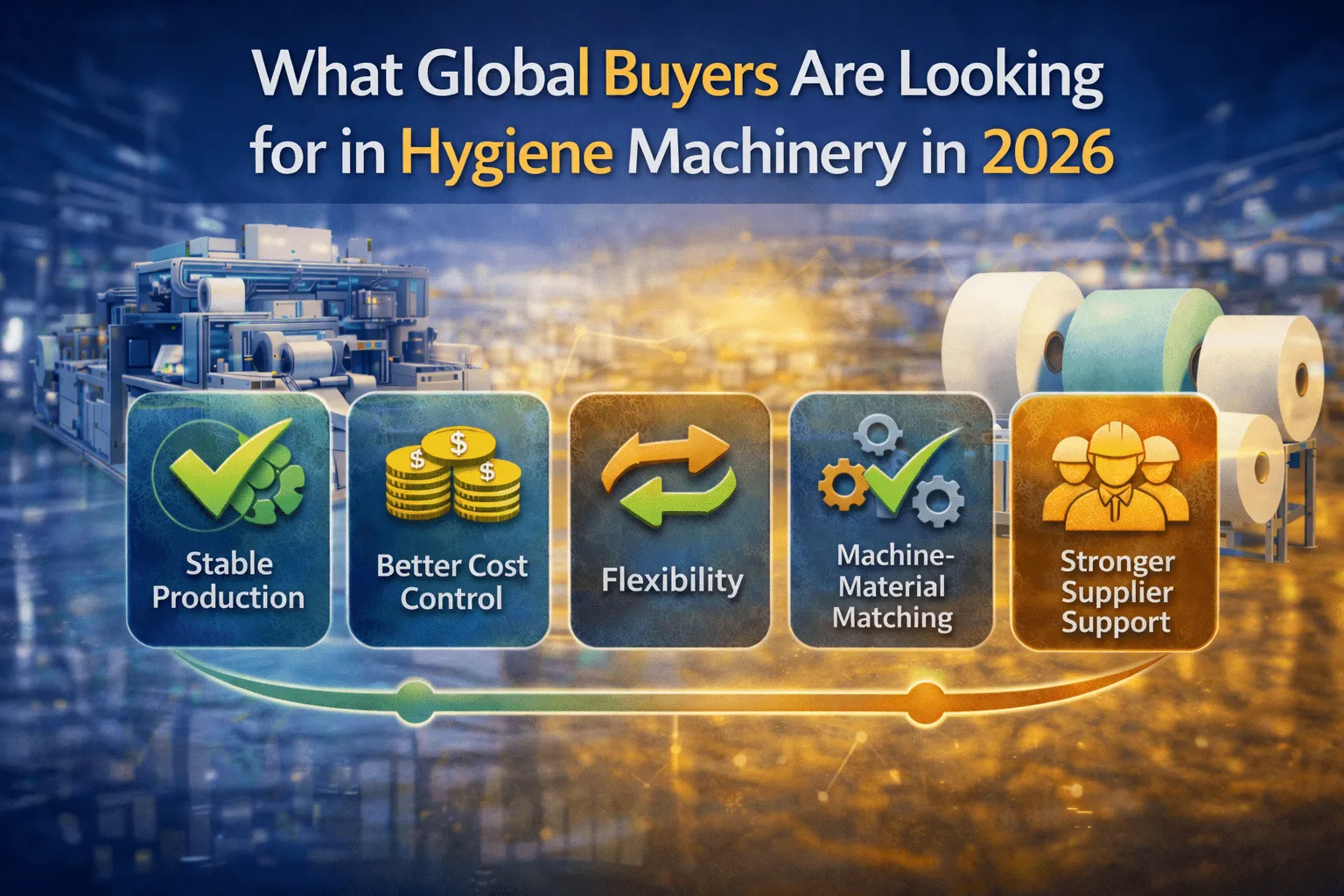
The hygiene machinery market has changed significantly in 2026. Global buyers are no longer evaluating machines based solely on speed, purchase price, or brand reputation. Instead, they are looking for machinery that delivers stability, adaptability, material compatibility, and total cost efficiency over time.
Trade continues to grow, but UNCTAD reports that fragility is increasing due to higher trade costs, geopolitical tensions, and supply chain uncertainties. Simultaneously, Reuters highlighted that manufacturers faced rising input prices and slower deliveries in March 2026, emphasizing the importance of selecting machinery that can perform reliably under volatile conditions.
Actually, this has shifted buyer priorities from short-term purchase decisions to long-term operational performance.
Table of Contents
- Why Buyer Priorities Have Shifted in 2026
- The Five Key Factors Buyers Evaluate
- Stability Over Speed: A Critical Focus
- Total Cost, Not Just Purchase Price
- Flexibility and Future-Proofing
- The Importance of Material-Machine Compatibility
- Strong Supplier Support Matters
- A Common Mistake Buyers Make
- Why Welldone
- Related Machines
- FAQ
- Conclusion
Why Buyer Priorities Have Shifted in 2026
Global buyers are now making decisions in a more fragile and cost-pressured environment. UNCTAD notes that trade growth in early 2026 continues but with heightened fragility due to tariffs, freight disruption, and geopolitical risks. Meanwhile, EDANA INDEX™26 emphasizes that the full value chain—from raw materials and machinery to converters—is now central to buyers’ evaluation, highlighting sustainability, technical excellence, and operational efficiency.
A common mistake is to assume that machine performance can be assessed independently of these external factors. In reality, total cost, reliability, and flexibility are now as critical as speed or upfront price.
The Five Key Factors Buyers Evaluate
Global buyers are increasingly focused on five aspects:
- Stable Production Output
Lines that run consistently, with fewer stoppages, wasted materials, or off-spec products, are prioritized over those boasting only high theoretical speeds. - Total Cost Efficiency
Rising energy, labor, and raw material costs mean buyers care more about total cost of ownership rather than the initial machine price. This aligns with Reuters’ reports of March 2026, where input cost volatility is forcing manufacturers to reconsider long-term operating efficiency. - Flexibility for Product Changes
Buyers expect machines to handle multiple SKUs, line changes, and future product upgrades with minimal downtime. - Material Compatibility
The machine must work smoothly with nonwovens, SAP, hot melt adhesives, PE films, composite films, and other critical raw materials. INDEX™26 reinforces that system-level compatibility is a must for modern hygiene production lines. - Strong Supplier Support
Installation, engineer guidance, startup support, and ongoing technical assistance are crucial for minimizing operational risk and ensuring production stability.
Stability Over Speed: A Critical Focus
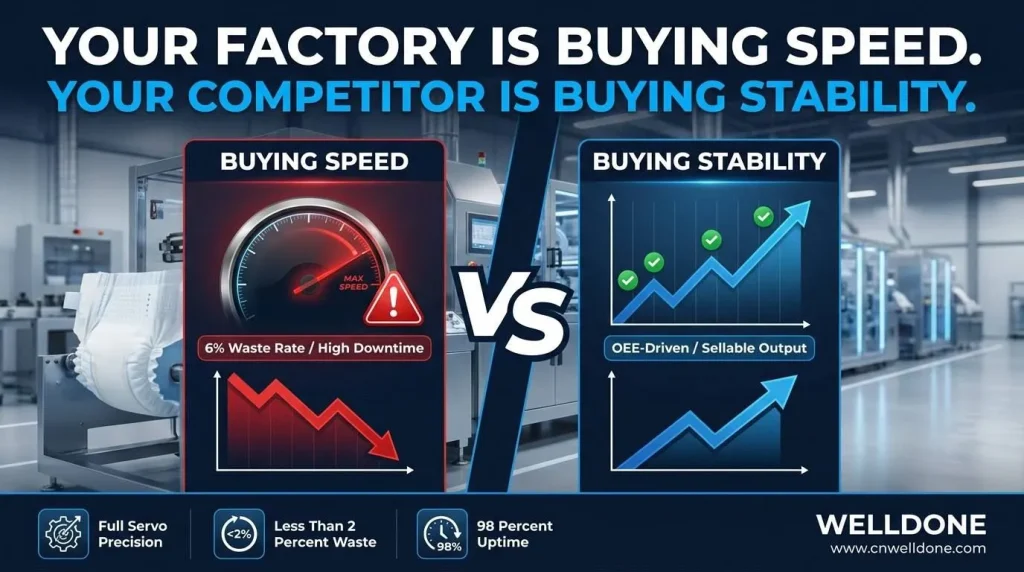
More importantly, global buyers now value stable output more than headline speed. A line that achieves maximum speed but struggles with waste, quality issues, or operator intervention is less desirable than a slightly slower line that runs predictably and consistently.
Total Cost, Not Just Purchase Price
While initial purchase cost is still a consideration, a machine that looks cheap on paper can lead to higher costs later due to:
- Increased labor requirements
- Material waste
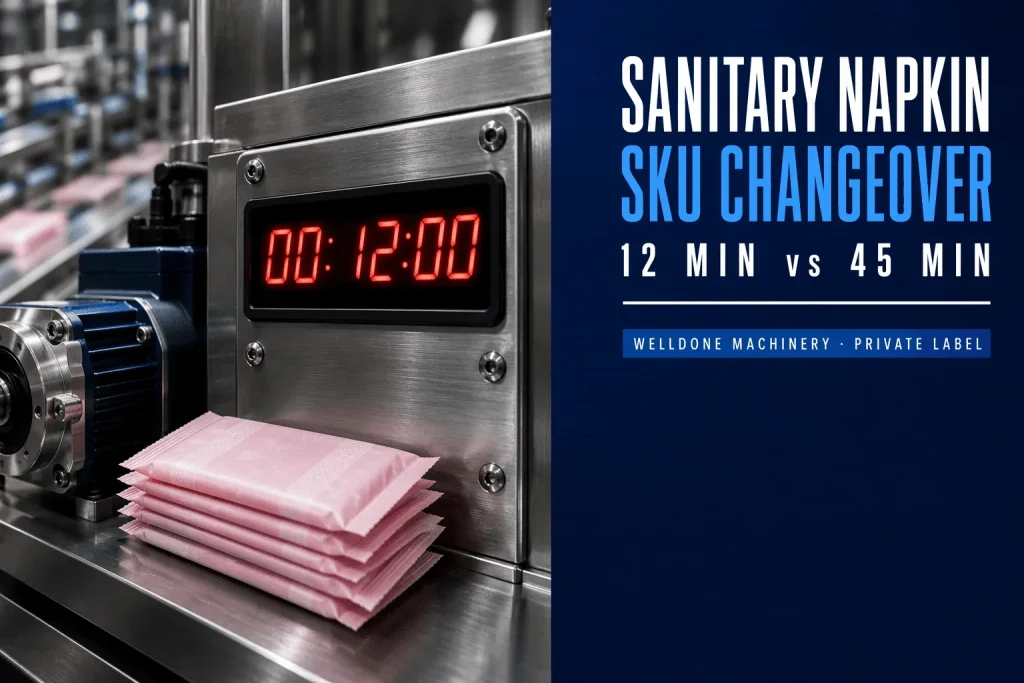
- Longer changeovers
- Downtime and maintenance pressure
I believe buyers who focus only on price risk underestimating the true cost of operation.
Flexibility and Future-Proofing
Machinery that can adapt to new product sizes, packaging formats, or market demand gives buyers a competitive edge. Flexibility is now considered a strategic advantage rather than a secondary feature.
The Importance of Material-Machine Compatibility
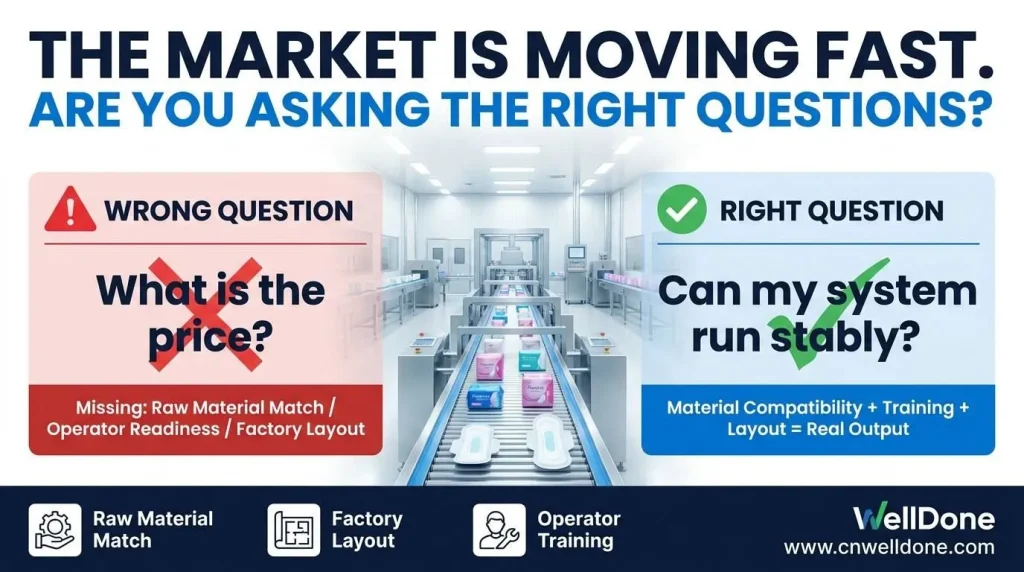
Poor machine-material matching is one of the most common reasons production lines underperform. Even advanced machines can fail if the materials are not compatible, resulting in unstable output, higher waste, and operator frustration.
Strong Supplier Support Matters
Suppliers who provide full lifecycle support—from machine selection and layout planning to installation, startup, and maintenance—are far more appealing to buyers than those offering equipment alone.
A Common Mistake Buyers Make
A common mistake is prioritizing machine speed or low price over long-term operational stability. This approach often leads to lines that underperform once production begins, negating any initial savings.
Why Welldone
Welldone supports buyers by providing a full-factory perspective, including:
- Machine selection guidance
- Raw material matching
- Layout planning
- Installation and startup support
- Long-term operational guidance
This holistic approach ensures new factories can maintain stable, efficient, and scalable production.
Related Machines
Depending on your project focus, this topic is relevant to:
- Baby diaper machine
- Pull-up diaper machine
- Sanitary napkin machine
- Panty liner machine
- Adult diaper machine
- Underpad machine
- Pet pee pad machine
- Wet wipes machine
- Tissue machine
FAQ
Q: Why is raw material compatibility so important?
A: Machines and materials must work together to ensure stable production, reduce waste, and maintain quality.
Q: Does flexibility matter for smaller factories?
A: Yes, even smaller factories benefit from lines that can adapt to product or packaging changes.
Q: Is a cheaper machine always a bad choice?
A: Not necessarily, but buyers should consider total cost, including labor, waste, and downtime.
Q: How does Welldone assist buyers?
A: We evaluate machinery and materials from a full-factory perspective, ensuring optimal performance and long-term stability.
Conclusion
Global buyers in 2026 are looking beyond speed and purchase price. They prioritize stable production, total cost efficiency, flexibility, material compatibility, and strong supplier support.
The right machine is part of a larger system. Success depends on aligning equipment, materials, and operational support to achieve predictable, efficient, and scalable output.