NEWS

Factory Layout for Hygiene Product Production: How Layout Decides Production Flow
factory-layout-production-flow-hygiene-machinery-linkedin-cover
Factory Setup Guide

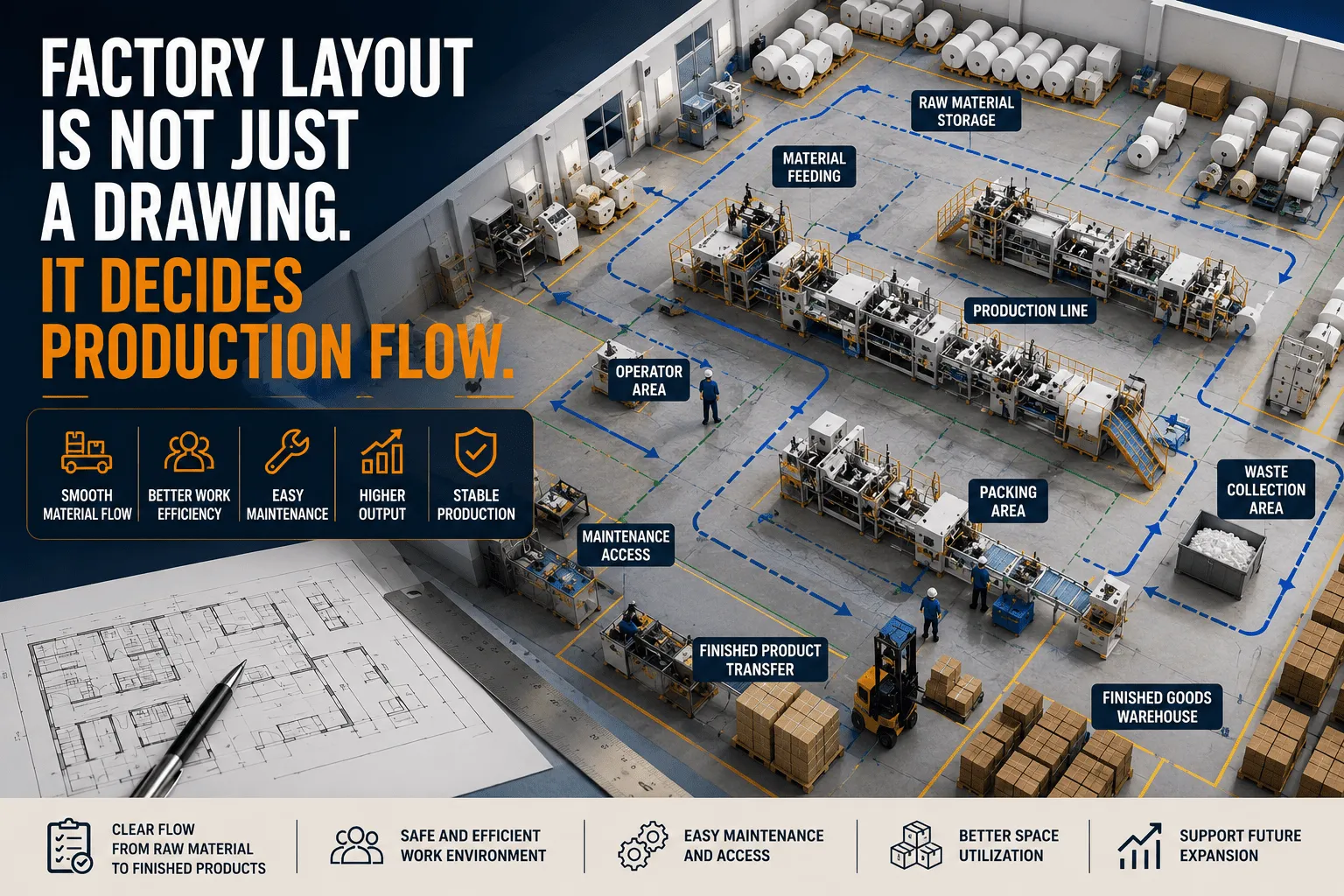
Factory Layout Is Not Just a Drawing: It Decides Production Flow

A hygiene product production line is not only about the machine itself. A good factory layout decides how raw materials move, how operators work, how waste is collected, how products are packed, and how stable daily production can become.

```

Why Factory Layout Is More Than a Floor Plan

Many buyers spend most of their time comparing machine speed, machine price, servo system, machine size, and product samples. These points are important, but they are not enough to build a stable factory.

After the machine arrives, another question becomes very real: can the factory run smoothly every day?

This is where factory layout becomes important. A good factory layout is not just a drawing for placing machines. It is the foundation of the whole production system.

For hygiene products such as baby diapers, sanitary napkins, adult diapers, underpads, pet pads, wet wipes, and tissue products, the layout directly affects production efficiency, product quality, labor cost, waste control, and daily factory management.

In simple words, a machine can only perform well when the whole production environment supports it.

A complete factory layout should answer practical questions before installation starts. Where should raw materials enter the factory? How far is the storage area from the production line? Is there enough space for operators to work safely? Can waste be collected without blocking production? Can finished products move smoothly to the packing area? Can engineers access the machine for maintenance?

If these questions are ignored, the machine may run well during testing, but daily production may become slow, crowded, and difficult to manage.

How Layout Affects Production Flow

Production flow means the movement from raw material to finished product. In a good layout, the flow should be clear, logical, and easy to manage.

Raw materials enter the factory, move to storage, go to material feeding, pass through the production line, continue to packing, and finally enter the finished goods warehouse.

01 Raw Material In
02 Material Feeding
03 Production Line
04 Packing Area
05 Finished Goods Out

If the layout is poor, the flow may become crossed, blocked, or repeated. Workers may need to move materials back and forth. Forklifts may interfere with operators. Finished products may be stored too close to raw materials. Waste collection may block the packing area.

These problems seem small at first, but they affect daily production. For example, a baby diaper production line may need nonwoven fabric, PE film, elastic materials, frontal tape, side tape, SAP, fluff pulp, hot melt adhesive, and packaging materials at the same time.

If these materials are placed too far from the feeding position, workers waste time moving them. If the feeding space is too narrow, changing materials becomes slow. If the packing area is not connected smoothly, finished products may pile up near the machine.

When we talk about machine capacity, we should not only ask how fast the machine can run. We should also ask whether the factory layout can support that capacity.

Raw Material Storage: The Starting Point of Stability

Raw material storage is often underestimated. In hygiene product manufacturing, raw materials are large, heavy, and sensitive to storage conditions.

Jumbo rolls need enough space. SAP and glue need proper storage. Packaging cartons should be easy to access. Materials should be protected from moisture, dust, and damage.

If raw material storage is not planned properly, production may face many hidden problems. Materials may be placed randomly. Operators may spend too much time finding the right roll. Wrong materials may be sent to the machine. Material surfaces may be damaged during movement. Production may stop because the next roll is not ready.

  • High-frequency materials should be closer to the production line.
  • Backup materials should have clear and fixed storage positions.
  • Material movement routes should be wide enough for forklifts or trolleys.
  • A preparation area should be placed near the feeding position.
  • Materials should be protected from moisture, dust, and damage.

This is especially important for high-speed hygiene machines. A stable production line does not wait for materials. Materials should always be ready for the machine.

Machine Positioning and Material Feeding

Machine positioning is the core of factory layout. A hygiene product machine is usually long and complex. It may include unwinding systems, forming sections, SAP or pulp systems, glue application, cutting, folding, stacking, rejection, and packing connection.

The machine needs enough space on both sides. One side may be used for material feeding. Another side may be used for operation, inspection, and maintenance.

If the machine is placed too close to the wall, maintenance becomes difficult. If the feeding side is too narrow, material changing becomes slow and unsafe. If the line is placed in the wrong direction, material flow and finished product flow may cross each other.

Material Feeding Route The feeding side should allow smooth movement of jumbo rolls, film rolls, nonwoven rolls, glue, cartons, and other materials.
Operator Movement Operators should be able to reach key operation points without crossing unsafe or crowded areas.
Maintenance Space The machine needs enough side space for cleaning, adjustment, spare parts replacement, and daily maintenance.
Packing Connection The product discharge direction should match the packing method and finished goods flow.

For example, when planning a sanitary napkin machine or baby diaper machine, the layout should not only show the machine outline. It should also show material roll positions, operator areas, inspection points, and packing connection.

Operator Working Area and Safety

A production line is not fully automatic without people. Even with a full servo machine, operators are still needed for material changing, machine setting, inspection, cleaning, troubleshooting, and daily maintenance.

So the layout must provide enough space for operators to work safely and efficiently.

If the operator area is too narrow, workers may feel uncomfortable. They may need to walk around obstacles. They may not be able to check the machine clearly. They may also face safety risks during material changing or machine adjustment.

  • Operators should be able to reach key operation points easily.
  • Workers should have enough space to observe product quality during production.
  • Material changing should be safe and convenient.
  • Emergency stop points should be easy to access.
  • Operator movement should not block forklifts or packing workers.

This is not only about comfort. It affects production stability. When operators have a clear working area, they can react faster when problems happen.

If material tension changes, they can adjust quickly. If glue application is abnormal, they can check early. If product size or sealing quality changes, they can identify the issue before too many defective products are produced.

Waste Collection and Quality Inspection

Every hygiene product factory needs a waste collection plan. During machine testing, product adjustment, material change, and daily production, waste is unavoidable.

If waste collection is not planned well, waste materials may pile up near the machine. This affects safety, cleanliness, and working efficiency.

For products like diapers, sanitary napkins, underpads, pet pads, and wet wipes, waste may include trimming waste, rejected products, packaging waste, nonwoven scraps, film scraps, or defective products.

The waste collection area should be close enough to the production line, but it should not block material feeding, operator movement, packing, or maintenance access.

At the same time, the factory also needs a quality inspection area. Product quality should not only be checked at the end of production. Operators should check samples during running.

The factory may need to inspect size, weight, absorbency, appearance, sealing, cutting, folding, and packing quality. If the inspection area is too far away, operators may check less often. If there is no clear inspection process, quality problems may be found too late.

A good layout supports both waste control and quality control. This helps the factory reduce material loss and improve sellable output.

Packing Area and Finished Goods Flow

Packing is often the place where production flow slows down. A production line may run well, but if the packing area cannot keep up, finished products will pile up.

This is especially common when buyers focus only on the main machine and ignore the connection between the production line and packing process.

For some factories, packing may be manual. For others, semi-automatic or automatic packing machines may be used. No matter which method is used, the packing area should be planned clearly.

  • The product transfer route should be short and smooth.
  • The packing machine position should match the discharge direction of the production line.
  • Carton and bag storage should be near the packing area.
  • Finished product temporary storage should not block the machine.
  • The finished goods route should connect smoothly to the warehouse.

If the packing area is too close to the machine without enough buffer space, it may become crowded. If it is too far away, product transfer becomes inefficient. If carton storage is not nearby, workers waste time moving packaging materials.

A smooth packing layout helps keep production continuous. For real factory operation, stable packing is just as important as stable machine running.

Utilities, Air Compressor, and Maintenance Access

A hygiene product machine depends on more than electricity. It may also need compressed air, glue system support, ventilation, cooling, stable power supply, and safe wiring.

If these utility systems are not considered in the layout, installation may become more difficult.

For example, the air compressor should be placed in a position that supports stable air supply and easy maintenance. Electrical cabinets should have enough space for safe operation. Glue systems should be located conveniently for operation and cleaning.

Power Supply Power route, cable position, cabinet access, and safety distance should be planned before installation.
Compressed Air Air compressor position and air pipe route should support stable pressure and easy maintenance.
Glue System The glue system should be convenient for operation, refilling, cleaning, and troubleshooting.
Maintenance Access Maintenance areas should not be blocked by raw materials, finished products, or temporary storage.

Many production problems are not caused by the machine itself. They may come from unstable power, insufficient air pressure, poor ventilation, difficult maintenance access, or unsafe wiring.

That is why factory layout should include utility planning. Before installation, the buyer should confirm power supply position, air compressor position, air pipe route, electrical cable route, glue system position, machine foundation requirement, ventilation condition, maintenance space, and safety access.

Future Expansion Should Be Planned Early

Many buyers start with one production line. But if the market grows, they may want to add another line, upgrade packing, expand warehouse space, or add new product categories.

If the first layout does not consider future expansion, the factory may face difficulties later.

For example, after installing one baby diaper machine, the buyer may later want to add a baby pull-up diaper machine. After starting with a sanitary napkin machine, the buyer may want to add a panty liner machine. After producing underpads, the buyer may want to add pet pad production.

If the factory layout is too tight from the beginning, adding new equipment becomes expensive and complicated.

Future expansion does not mean the buyer needs to build everything at once. It means the layout should leave reasonable space and flow direction for future development.

A good layout should help the factory grow. It should not only solve today’s production needs, but also support tomorrow’s business plan.

Common Layout Mistakes Buyers Should Avoid

Many factory problems can be avoided if layout planning is done carefully before installation. Below are some common mistakes that buyers should pay attention to.

1. Only Planning the Machine Position

Some buyers only ask where the machine should be placed. They do not plan raw material flow, packing flow, waste collection, or operator movement. This creates problems after production starts.

2. Ignoring Raw Material Movement

Raw materials are large and heavy. If the movement route is not planned, production becomes slow and messy.

3. Leaving Too Little Space Around the Machine

The machine needs space for operation, cleaning, adjustment, and maintenance. A tight layout may save space in the beginning, but it creates long-term trouble.

4. Separating Production and Packing Too Far

If the packing area is not connected smoothly, finished products may pile up and reduce production efficiency.

5. Forgetting Waste Collection

Waste must have a clear collection route. Otherwise, the production area becomes crowded, dirty, and unsafe.

6. Not Considering Utilities

Power, compressed air, glue system, ventilation, and maintenance access should be planned together with the machine.

7. No Space for Future Expansion

A factory should not only solve today’s needs. It should also leave room for tomorrow’s growth.

How Welldone Supports Factory Layout Planning

At Welldone, we understand that buying a machine is only one part of building a production factory.

A successful hygiene product factory needs the right machine, suitable raw materials, trained operators, stable installation, and practical factory layout planning.

We support customers by helping them think through the full production process before the machine is installed. This includes product planning, machine configuration, raw material matching, layout suggestion, installation support, operator training, and production guidance.

Product Planning We help buyers define product type, product size, capacity target, and market positioning before choosing the machine.
Machine Configuration We suggest suitable machine configuration according to the product plan, labor condition, and production target.
Layout Suggestion We help customers think through raw material flow, operator area, packing route, waste collection, and future expansion.
Installation Support We support installation, commissioning, operator training, and production handover for stable factory operation.

For different products, the layout logic may be different. A baby diaper production line needs enough space for multiple raw materials and product size change. A sanitary napkin production line needs stable material feeding, cutting accuracy, and packing connection. An adult diaper machine may require more space because the product size is larger.

An underpad or pet pad line needs smooth material flow and large finished product handling space. A wet wipes line needs clean production planning, liquid system consideration, folding, cutting, counting, and packing connection. A tissue line needs jumbo roll handling, embossing, cutting, folding, and packing process planning.

That is why one layout cannot fit all factories. Each factory should be planned according to product type, production capacity, factory size, labor condition, packing method, and future development plan.

Welldone focuses on helping buyers build a production system, not only deliver a machine.

Conclusion

Factory layout is not just a drawing. It is the foundation of production flow.

A good layout helps raw materials move smoothly, operators work safely, machines run efficiently, waste stay controlled, packing remain stable, and finished products leave the factory in an organized way.

For hygiene product manufacturing, layout planning should start before machine installation. When the layout is planned well, the factory becomes easier to manage. When the flow is smooth, the machine can perform better.

When operators have enough space and clear working routes, production becomes more stable. When packing, storage, utilities, and maintenance are considered early, the factory can avoid many unnecessary problems.

In the end, a successful production line is not only about machine speed. It is about building a complete system that can support stable production every day.

Welldone helps customers think beyond the machine and plan for real factory operation. From machine selection to layout planning, from installation to operator training, from trial production to stable production, we support customers all the way.

FAQ

1. Why is factory layout important for hygiene product production?

Factory layout affects raw material movement, operator efficiency, machine operation, waste collection, packing flow, and finished goods storage. A good layout helps the factory run more smoothly and reduces unnecessary production problems.

2. Is factory layout only about placing the machine?

No. Machine placement is only one part. A complete layout should also include raw material storage, feeding routes, operator areas, packing area, waste collection, utility systems, maintenance access, and future expansion space.

3. When should factory layout planning start?

Layout planning should start before machine installation. It is better to plan the production flow before the machine arrives, so the factory can prepare power, air supply, material storage, packing area, and working space in advance.

4. What happens if the factory layout is poor?

Poor layout may cause slow material movement, crowded working areas, difficult maintenance, blocked packing flow, high waste, unstable production, and lower real output.

5. Does machine speed depend on factory layout?

Machine speed depends mainly on machine design, but real production output is also affected by layout. If materials, operators, packing, and waste collection cannot keep up, the machine cannot deliver stable sellable output.

6. What should be considered around the machine area?

The machine area should have enough space for material feeding, operator movement, inspection, adjustment, cleaning, maintenance, electrical cabinets, glue systems, and emergency access.

7. Why is raw material storage important?

Hygiene product raw materials are large and sensitive. Proper storage helps protect materials, reduce damage, improve feeding efficiency, and prevent production delays.

8. Should packing area be planned together with the machine?

Yes. Packing is part of the full production flow. If packing cannot keep up with the production line, finished products may pile up and affect production efficiency.

9. How much space should be left for future expansion?

This depends on the factory size, product plan, and business goals. In general, it is smart to leave space for another production line, packing upgrade, warehouse expansion, or new product category.

10. Can Welldone help with factory layout planning?

Yes. Welldone can provide layout suggestions based on product type, machine configuration, factory size, raw material flow, packing method, and future development plan.

Plan Your Hygiene Product Factory with Welldone

A good production line starts before installation. If you are planning a baby diaper, sanitary napkin, adult diaper, underpad, pet pad, wet wipes, or tissue production factory, Welldone can support you from machine selection to layout planning and stable production.

Website: www.cnwelldone.com
Email: welldone@cnwelldone.com