After-Sales Support for Hygiene Product Machines: More Than Fixing Problems

On June 26, 2026
Comments Off on After-Sales Support for Hygiene Product Machines: More Than Fixing Problems
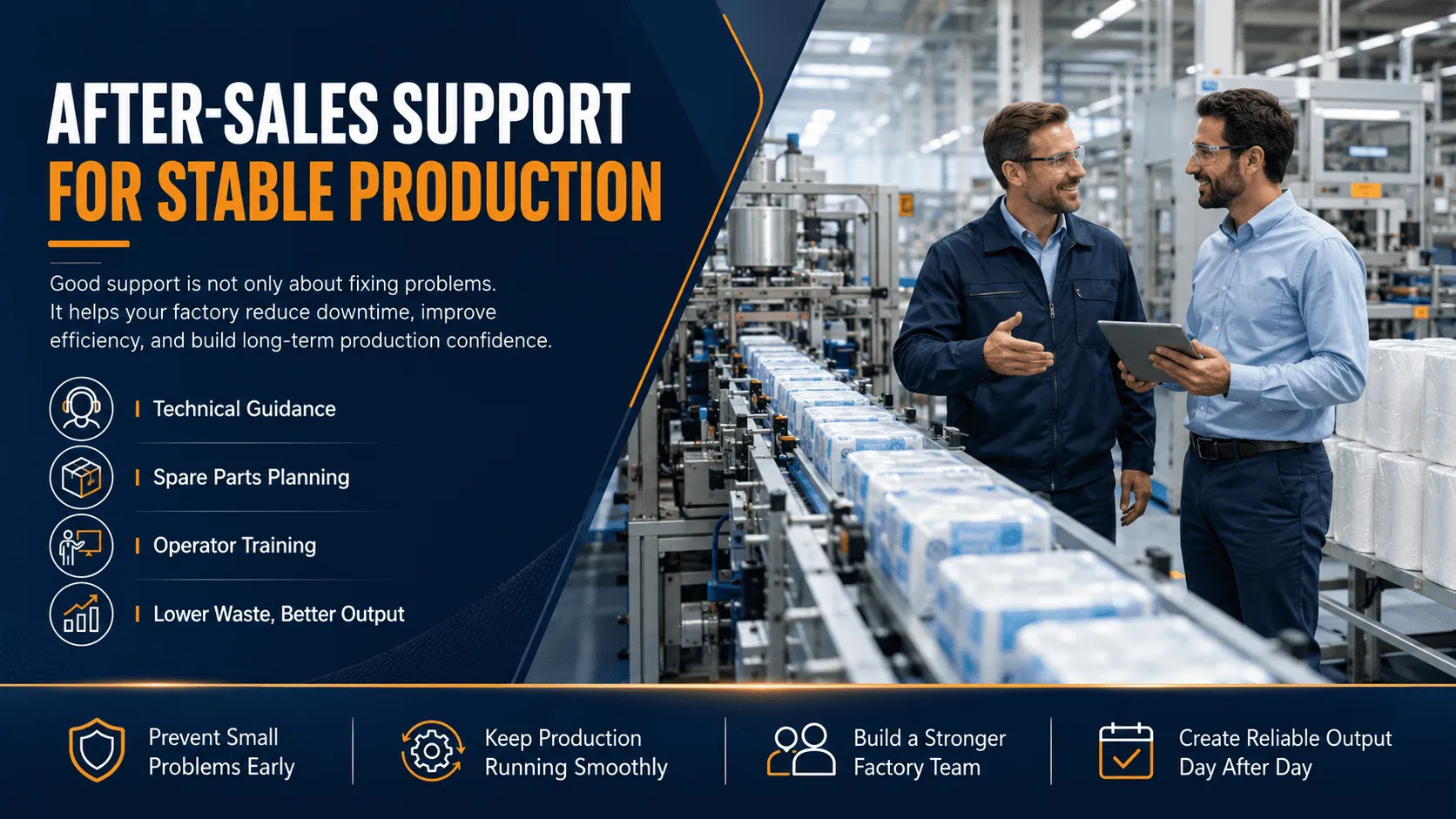
After-Sales Support Guide
After-Sales Support Is Not Just Fixing Problems: It Helps Keep Production Stable
In hygiene product manufacturing, good after-sales support should not only be about emergency repair. It should help the factory keep production stable before small problems become big problems.
```
```
Why After-Sales Support Matters in Hygiene Product Manufacturing
Many buyers think after-sales support starts when something goes wrong.
A machine stops. A spare part needs replacement. A product defect appears. The operator cannot solve an adjustment problem. Then the supplier is contacted.
This is a common understanding, but it is not enough.
In real hygiene product manufacturing, good after-sales support should not only be about emergency repair. It should help the factory keep production stable before small problems become big problems.
For baby diapers, sanitary napkins, adult diapers, underpads, pet pads, wet wipes, and tissue products, daily production depends on many details. Machine settings, raw material matching, operator habits, glue temperature, tension control, packing rhythm, spare parts preparation, and maintenance routines all affect the final output.
After-sales support is not only about fixing problems. It is about helping the customer build the ability to run the production line better every day.
If these details are not managed well, the machine may still run, but the factory may face unstable quality, higher waste, lower efficiency, and more unexpected downtime.
That is why after-sales support should be seen as part of the production system.
After-Sales Support Should Start Before Problems Happen
Many people think after-sales support begins after the machine breaks down.
But professional support should start much earlier.
It should begin during project planning, continue through installation, support trial production, and stay available during daily production.
01
Project Planning
02
Installation
03
Trial Production
04
Daily Support
Before production starts, support may include factory layout suggestions, raw material preparation guidance, machine installation planning, air compressor and power requirement confirmation, and operator training preparation.
During installation, support includes machine assembly, commissioning, test running, product adjustment, and training the buyer’s team.
During trial production, support helps the customer understand product quality, material behavior, machine settings, speed adjustment, waste control, and packing flow.
After stable production starts, support continues with spare parts planning, troubleshooting, maintenance advice, and long-term technical communication.
Prevention is always better than downtime.
Emergency repair solves a problem after it happens. Preventive support helps reduce the chance of the same problem happening again.
Stable Production Depends on Daily Details
A hygiene product machine is a complex production system.
Even when the machine structure is strong, stable production still depends on daily operation details.
Glue Temperature
If the temperature is too low, bonding may be weak. If it is too high, glue performance may be affected or material may be damaged.
Material Tension
If tension changes too much, product shape, cutting accuracy, folding, and sealing may be affected.
Operator Habits
If operators only know how to press buttons, they may not solve production problems quickly.
Packing Rhythm
If packing is too slow, finished products may pile up and the production line may need to slow down.
Maintenance routines also matter. If small parts are not checked, cleaned, or replaced on time, small issues can become bigger failures.
These details may not look important during a short machine demonstration, but they matter every day in real factory operation.
Good after-sales support helps the customer pay attention to these details and move from basic operation to stable management.
Technical Guidance Helps Buyers Understand the “Why”
One important part of after-sales support is technical guidance.
When a problem happens, it is not enough to simply tell the customer what button to press.
The customer should also understand why the problem happened.
- If product cutting is unstable, the reason may be material tension, blade condition, speed setting, product size adjustment, or material feeding.
- If diaper elastic position is not stable, the issue may come from material feeding, glue application, tension control, or operator adjustment.
- If sanitary napkin sealing is not strong enough, the problem may be related to temperature, pressure, material thickness, or sealing time.
- If wet wipes counting or folding is unstable, the issue may come from material quality, moisture condition, folding mechanism, or speed matching.
A good supplier does not only give a quick answer. A good supplier helps the customer understand the logic behind the problem.
This is important because it helps the buyer’s team become stronger.
When operators understand the cause, they can adjust faster next time. When supervisors understand the process, they can manage production better. When the factory understands the machine logic, daily downtime can be reduced.
Operator Training Reduces Downtime and Waste
Operator training is one of the most important parts of after-sales support.
A machine can be advanced, but if operators are not trained well, the factory may still face unstable production.
Operators need to understand more than basic running. They should know how to prepare materials, start the machine correctly, check product quality, adjust settings, handle alarms, change sizes, clean key parts, and report problems clearly.
Size change is especially important in hygiene product manufacturing.
Baby Diapers
Different sizes require stable size change, elastic control, SAP adjustment, and product quality checking.
Sanitary Napkins
Different lengths and styles require accurate cutting, sealing, folding, and packaging adjustment.
Adult Diapers
Larger products need stable absorbency, stronger material handling, and careful packing flow.
Underpads & Pet Pads
Different dimensions require stable material feeding, cutting, folding, stacking, and packing control.
If operators do not follow a clear size change process, the factory may lose time and materials during every adjustment.
Training helps reduce this waste. It also helps operators build confidence.
A confident operator can identify problems earlier, communicate better, and keep the line more stable.
Spare Parts Planning Protects Production Continuity
Spare parts are often discussed only when something breaks.
But for a factory, spare parts planning should be done before production stops.
Some parts are wearing parts. They may need regular replacement after long-term use. Some parts are critical parts. If they fail and there is no spare part available, production may stop for a long time.
- Cutting blades
- Belts and bearings
- Sensors and electrical components
- Glue system parts
- Sealing parts
- Air components
- Other common wearing parts based on the machine type
The goal is not to let the buyer buy unnecessary parts. The goal is to protect production continuity.
If a key part fails during peak order season, the cost is not only the part itself. The factory may lose production time, delivery schedule, labor efficiency, and customer trust.
A practical spare parts plan helps the factory respond faster.
It also makes maintenance more predictable and supports long-term production management.
Preventive Maintenance Is Better Than Emergency Repair
Every machine needs maintenance.
But not every factory has a clear maintenance habit.
Some factories only pay attention when the machine stops. This creates risk.
Preventive maintenance means checking and maintaining the machine before serious problems happen.
- Cleaning and lubrication
- Checking air pressure
- Checking tension systems
- Inspecting belts and chains
- Checking sensors and electrical cabinets
- Checking glue systems
- Confirming safety devices
Preventive maintenance helps reduce sudden downtime. It also helps keep product quality stable.
For example, if cutting parts are not maintained, product edges may become uneven. If glue systems are not cleaned properly, bonding quality may change. If rollers are not checked, material movement may become unstable. If sensors are dirty or damaged, rejection or counting may become inaccurate.
Good after-sales support should help customers build a maintenance routine that matches real production conditions.
Raw Material Matching and Machine Adjustment
In hygiene product manufacturing, not every problem is caused by the machine.
Many problems are related to raw materials and machine adjustment.
Different nonwoven fabrics, films, absorbent cores, SAP, fluff pulp, elastic materials, hot melt adhesives, and packaging materials may behave differently on the same machine.
If the material thickness, strength, softness, tension, or surface treatment changes, the machine settings may also need adjustment.
Diaper Production
A machine may run well with one nonwoven supplier, but when the material supplier changes, tension and forming results may also change.
Sanitary Napkin Production
Film thickness, glue type, core structure, and sealing conditions may require different machine settings.
Underpad Production
Product size, absorbent layer structure, and material width can affect cutting, folding, and stacking stability.
Wet Wipes Production
Material moisture, folding behavior, cutting condition, and packing speed must work together.
Good after-sales support helps buyers understand the relationship between materials and machine performance.
This reduces unnecessary misunderstanding and helps the buyer improve production stability when changing materials or developing new products.
After-Sales Support for Different Hygiene Product Lines
Different hygiene product lines require different support focus.
- A baby diaper production line needs attention to elastic application, SAP distribution, waist structure, material tension, size change, and packing flow.
- A sanitary napkin production line needs support for core forming, sealing quality, wing folding, cutting accuracy, product length, and individual packaging.
- An adult diaper production line usually involves larger product size, higher material consumption, stronger absorbency requirements, and more space for packing and storage.
- An underpad machine needs stable material feeding, accurate cutting, smooth folding, strong stacking, and efficient packing.
- A pet pad machine needs flexible size control, stable absorbent structure, smooth material flow, and cost control for competitive markets.
- A wet wipes machine needs attention to liquid system, folding method, cutting accuracy, counting, sealing, and hygiene production conditions.
- A tissue machine needs stable web handling, embossing, cutting, folding, stacking, and packing connection.
After-sales support should match the product type, machine configuration, factory condition, and buyer’s production goal.
What Buyers Should Expect from a Reliable Supplier
When choosing a machine supplier, buyers should not only ask about machine price and delivery time.
They should also ask about support after delivery.
A reliable supplier should provide clear communication, practical technical guidance, training support, spare parts advice, installation support, and long-term service attitude.
- How will the supplier support installation?
- Will engineers help with commissioning and operator training?
- Can the supplier guide machine adjustment during trial production?
- Can the supplier explain common quality problems and solutions?
- Are spare parts available?
- Does the supplier understand raw materials and product structure?
- Can the supplier support long-term technical communication?
- Does the supplier only sell machines, or can it help with factory production planning?
These questions are important because a machine purchase is not a one-day transaction. It is a long-term production project.
A good supplier should help the buyer reduce risk, not only complete delivery.
Long-term technical support is part of real production capability.
How Welldone Supports Long-Term Production Stability
At Welldone, we believe that after-sales support is part of production capability.
We do not only deliver machines. We help customers build the ability to run them better.
Our support covers different stages of the factory project, including product planning, machine configuration, factory layout suggestion, raw material matching, installation support, operator training, spare parts guidance, and long-term production communication.
Before Machine Arrival
We help buyers understand factory preparation, material preparation, layout planning, power supply, air compressor, and production conditions.
During Installation
We support machine commissioning, test running, operator training, product adjustment, and production handover.
During Trial Production
We help customers improve product quality, reduce waste, understand machine adjustment, and stabilize output.
Long-Term Production
We support spare parts planning, maintenance advice, technical discussion, and production improvement when conditions change.
This full-cycle support is important because stable production does not come from the machine alone.
It comes from the combination of machine, materials, operators, layout, maintenance, packing, quality control, and management.
Welldone focuses on helping customers think beyond the machine and build a stronger production system.
Related Machines
Different hygiene product categories have different support needs. Welldone provides production lines and long-term support for baby care, female care, adult care, pet care, wet wipes, and tissue products.
Baby Care Machines
Baby diaper machines and baby pull-up diaper machines support different baby hygiene product structures, sizes, and market requirements. Stable after-sales support helps factories improve size change, material matching, and long-term operation.
Learn MoreFemale Care Machines
Sanitary napkin machines, panty liner machines, and related female care production lines require stable sealing, accurate cutting, smooth folding, and reliable packaging support.
Learn MoreAdult Care Machines
Adult diaper machines, adult pull-up diaper machines, and underpad machines need stable production planning, material control, and strong packing flow for large-size hygiene products.
Learn MorePet Care Product Machines
Pet pad machines and pet diaper machines support flexible product sizes and cost-effective production for growing pet hygiene markets.
Learn MorePaper & Wet Wipes Machines
Wet wipes machines, tissue machines, facial tissue machines, napkin machines, and related packing machines require stable folding, cutting, counting, and packing support.
Learn MoreConclusion
After-sales support is not just fixing problems.
It is helping the factory build stable production ability.
In hygiene product manufacturing, the machine is important, but daily production depends on many details. Operators, materials, settings, spare parts, maintenance, quality control, packing, and factory management all affect the final output.
A strong supplier should not only respond when the machine stops.
A strong supplier should help customers understand problems, prevent repeated issues, train factory teams, plan spare parts, and improve production stability step by step.
Machine delivery is not the end of the project. It is the beginning of long-term production support.
For buyers, this kind of support reduces risk. For factories, it protects output. For long-term business, it builds confidence.
From installation to training, from spare parts to technical guidance, from problem solving to stable production improvement, Welldone supports customers all the way.
FAQ
1. Why is after-sales support important for hygiene product machines?
After-sales support helps factories solve technical problems, reduce downtime, train operators, prepare spare parts, improve maintenance, and keep production stable after machine installation.
2. Is after-sales support only about repairing the machine?
No. Good after-sales support is not only emergency repair. It also includes installation guidance, operator training, troubleshooting, spare parts planning, preventive maintenance, and long-term technical support.
3. How can after-sales support improve production stability?
It helps customers understand machine settings, raw material matching, maintenance routines, quality control, and adjustment logic. This reduces repeated problems and helps the production line run more smoothly.
4. Why is operator training part of after-sales support?
Operators directly affect daily production. Proper training helps them reduce downtime, control waste, handle size changes, identify problems early, and keep the machine running stably.
5. Why should spare parts be planned in advance?
Some parts wear out during long-term production. If key spare parts are not prepared, a small part failure may stop the whole production line. Spare parts planning protects production continuity.
6. What is preventive maintenance?
Preventive maintenance means checking, cleaning, lubricating, and maintaining the machine regularly before serious problems happen. It helps reduce sudden downtime and keeps product quality stable.
7. Can raw materials affect machine performance?
Yes. Different materials may behave differently on the same machine. Material thickness, strength, softness, tension, glue performance, and surface treatment can all affect production stability.
8. What should buyers ask suppliers about after-sales support?
Buyers should ask about installation support, operator training, spare parts availability, troubleshooting guidance, maintenance advice, raw material matching support, and long-term technical communication.
9. Does Welldone provide support after machine delivery?
Yes. Welldone supports customers with installation, commissioning, operator training, spare parts guidance, technical communication, and long-term production support.
10. What is the real value of good after-sales support?
The real value is not only solving one problem. It is helping the factory reduce downtime, improve efficiency, lower waste, train the team, and create stable sellable output every day.
Build Stable Production with Welldone
Good after-sales support is not only about fixing problems. It is about helping your factory run better, reduce waste, improve output, and build long-term production confidence.
Website: www.cnwelldone.com
Email: welldone@cnwelldone.com