Sanitary Napkin Machine: Building Stable Production in New Markets

On July 6, 2026
Comments Off on Sanitary Napkin Machine: Building Stable Production in New Markets
Sanitary Napkin Machine: Building Stable Production in New Markets
The inquiry pattern is almost always the same. A buyer contacts us, shares their target market, asks for machine specifications, and then asks for price. They have done their homework on the product. They know what absorbency grade they want to produce. They have visited a trade show or watched factory videos online. They feel ready to move.
What they are usually not ready for is the first month of actual production.
Not because the machine fails. Because the production system around the machine — the raw materials, the operators, the factory layout, the quality process — was not built alongside it. And in sanitary napkin manufacturing, those gaps show up fast. Sealing failures on shift two. Wing folding inconsistency by day four. Individual packaging jams that nobody on the team knows how to trace back to a root cause.
The machine did not cause those problems. The machine revealed them. Understanding that difference before you invest is what separates a factory that ramps up smoothly from one that spends its first six months troubleshooting.
"A sanitary napkin machine that runs stably is not a standard purchase. It is a configured production system — and the configuration starts before the machine is built."
1. The Question Every Buyer Asks First — and Why It Is the Second Question
Price is the first question almost every buyer asks. That is understandable. The machine is the largest single capital expenditure in a new sanitary napkin factory. Getting it wrong costs money that is hard to recover.
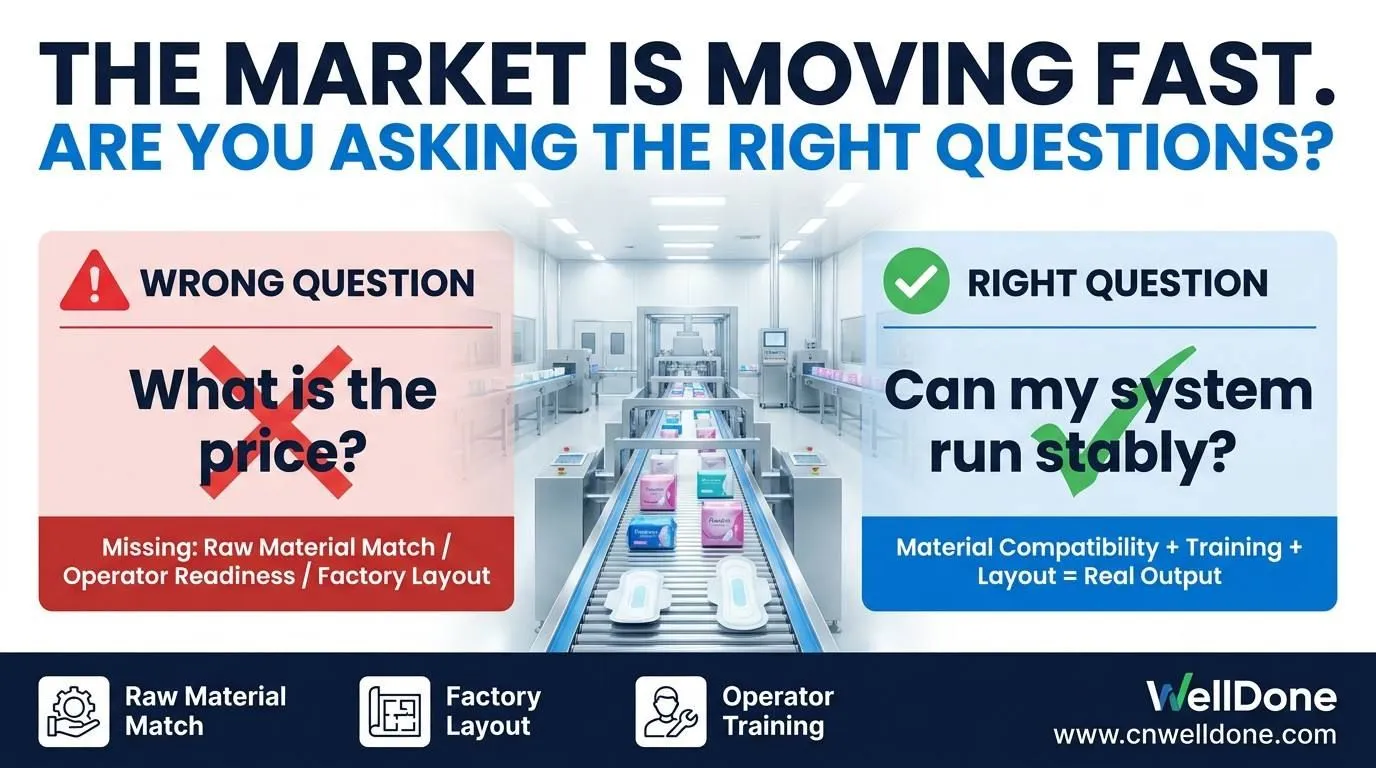
But price is the second question, not the first. The first question is whether the machine — at any price — can run stably in your specific factory conditions, with your local raw materials, operated by a team that is learning the process for the first time.
Actually, a machine that costs 20 percent less but requires raw material grades that are not available in your local supply chain will spend its first three months running at 40 percent OEE while your team hunts for alternative materials. The total cost of that downtime — lost output, operator overtime, engineering consultations, expedited material shipments — will typically exceed the price difference within the first quarter of operation.
The correct sequence is: confirm your raw material supply chain first, design your factory layout for the production flow, build your operator team, then select a machine that is compatible with all three. Most buyers do it in reverse. The machine arrives, and then the scramble begins.
2. Raw Material Compatibility: Where Most New Factories Lose the First Month
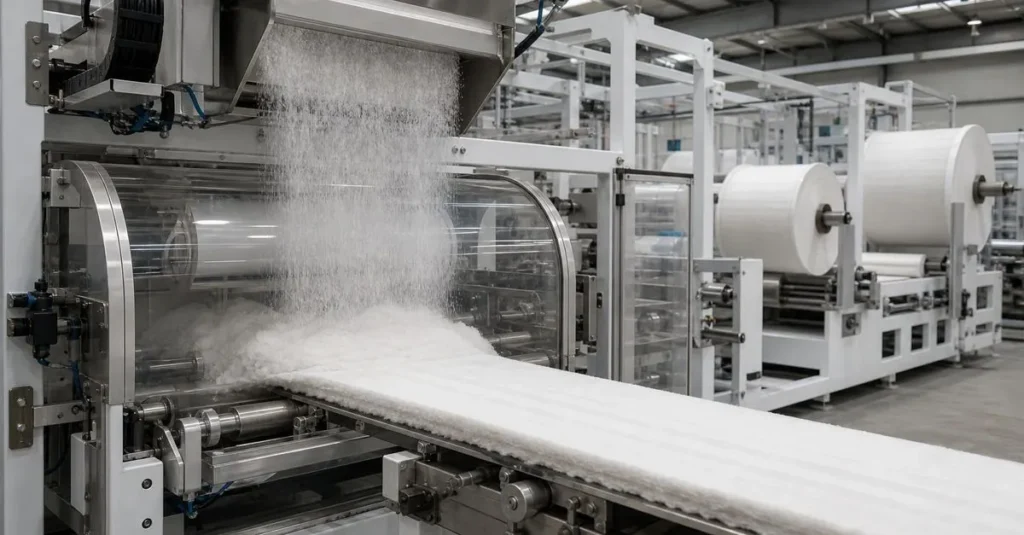
Sanitary napkin machines are calibrated during factory acceptance testing with specific raw material grades. The non-woven fabric has a defined weight, surface treatment, and tension behavior. The fluff pulp has a defined absorption rate and fiber length. The hot melt adhesive has a defined application temperature range and open time. The individual packaging film has a defined sealing temperature and thickness.
When a buyer sources raw materials locally after the machine arrives, those materials are rarely identical to what the machine was calibrated with. The surface treatment on the non-woven may be slightly different, which changes how the hot melt adheres. The fluff pulp from a different supplier may have a different fiber length, which changes core formation density. The packaging film may seal at a slightly different temperature — meaning the sealing bar setting that worked in the factory acceptance test creates weak seals, or burn marks, with the local material.
None of these are machine failures. They are compatibility gaps. An operator who has not been trained to identify and adjust for these gaps will either keep running product that fails quality checks, or shut the line down waiting for a technician to fly in.
The real question is not whether your machine can run your materials. The question is whether anyone confirmed that compatibility before the machine was built — when adjustments are free and take days, not weeks of production downtime.
- Share local raw material spec sheets with the machine manufacturer during the design phase, not after delivery.
- Test seal strength with your local packaging film at different temperature settings before production starts.
- Confirm fluff pulp absorption rate matches your target product absorbency specification.
- Check release paper peel force against the machine's dispensing tension setting before first run.
3. Factory Layout: The Decision That Is Hardest to Change Later
Factory layout is the decision that most first-time hygiene product investors underestimate — and it is the hardest to fix after production starts.
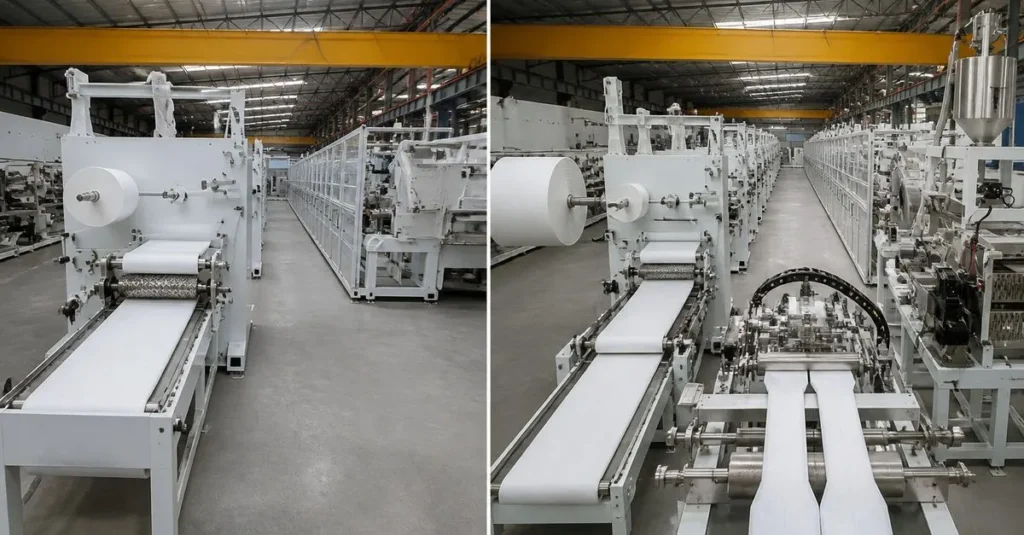
A sanitary napkin production line is not just the machine. It is the machine plus raw material storage, plus the feeding path from storage to the line, plus the finished product transfer area, plus the packing station, plus the quality inspection zone, plus the operator movement paths between all of those areas. Get the layout wrong and you create bottlenecks that slow the whole operation regardless of how fast the machine runs.
The most common layout mistake in new factories is placing raw material storage too far from the production line. A non-woven roll that takes two people four minutes to move from storage to the line creates a micro-stop every time a roll change happens. At 300 units per minute, four minutes of unplanned downtime is 1,200 units of lost output. If roll changes happen six times per shift, that is 7,200 units per shift — before accounting for any other downtime source.
- Raw material storage should be adjacent to the line, not across the factory floor.
- The finished product transfer path should flow away from the line without crossing the operator work zone.
- The quality inspection station should sit between production output and the packaging area — not at the end after product is already boxed.
- Aisle width around the machine should allow a full roll change without stopping for equipment movement.
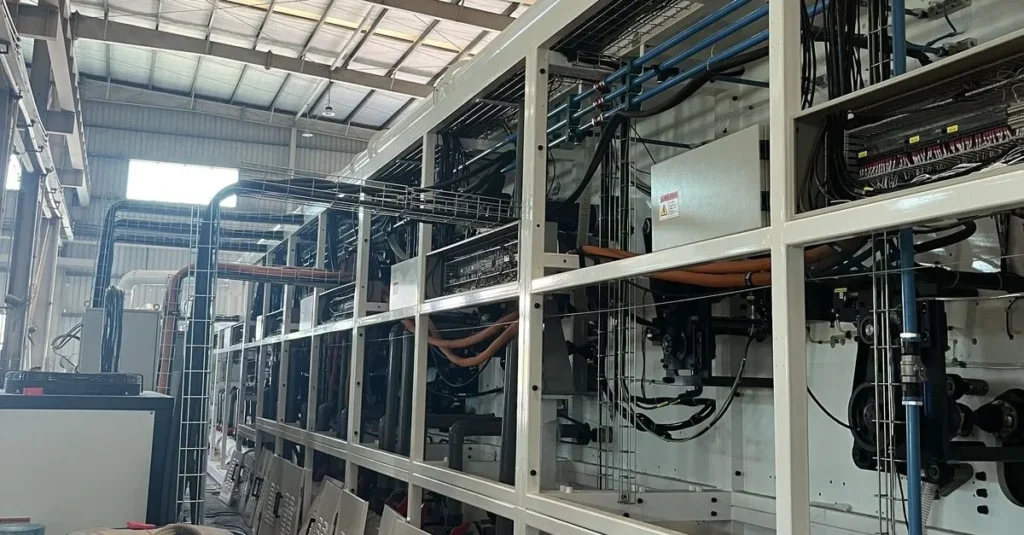
- Electrical cabinet and air supply connections should be accessible without shutting down the line for routine checks.
4. Operator Training: The Investment That Pays Back Every Single Shift
Sanitary napkin machines run well when operators understand what they are managing — not just which buttons to press, but why the machine behaves the way it does when materials change, when temperature shifts during the afternoon, or when the line speeds up after a slow startup.
An operator who understands that sealing quality is affected by the combination of bar temperature, dwell time, and film thickness can diagnose a weak seal in three minutes and correct it without stopping the line. An operator who only knows that "the seal button controls sealing" will either overheat the film trying to fix it or shut the line down and call for help.
The difference across a full production week is measurable in tens of thousands of units. At 300 units per minute, a 10-minute reduction in average daily downtime per shift is 3,000 units per shift. Over five working days, that is 15,000 additional sellable products per week — from the same machine, the same materials, the same factory. Just from operators who understand what they are managing.
I believe operator training is the most underfunded line item in new hygiene product factory budgets. Buyers spend months negotiating machine price and almost no time planning training scope, training duration, or which operators will be trained to what depth before production starts. The machine arrives, engineers install it, run it for a week, and leave. What happens next depends entirely on how well the team was prepared.
5. Size Changeover: A Test of Whether the Factory Is Really Ready
Most sanitary napkin factories produce more than one product size. Every size changeover is a test. Not of the machine. Of the factory.
A well-prepared factory completes a size changeover in 45 to 60 minutes, with minimal waste during the adjustment period. A factory where the process has not been documented, practiced, and standardized will take three to four hours — with significant material waste as operators trial-and-error their way back to stable output.
The difference is not machine quality. The difference is whether the factory has a documented changeover procedure, whether operators have practiced it under supervision, and whether the settings for each product size are recorded so they can be recalled instead of rediscovered every time.
In most cases, factories that invest in changeover documentation during the installation phase recoup that investment within the first three months — just from reduced downtime and lower material waste during size transitions.
6. Quality Control: It Starts at the Machine, Not at the End of the Line
Many new sanitary napkin factories inspect product at the end of the packaging line. A team member checks a sample every thirty minutes and looks at sealing appearance, product length, and wing symmetry by eye.
At 300 units per minute, thirty minutes of production is 9,000 units. If a sealing problem developed at the fifteen-minute mark, 4,500 units with compromised seals have already been individually packaged before anyone catches it.
The practical solution is training operators to perform systematic checks at defined intervals during production — not just at the end. Core weight check every 200 units. Seal integrity test every 500 units. Wing fold measurement every 300 units. These checks take less than two minutes each and can catch problems when they affect dozens of products, not thousands.
When your team knows what to look for, they become the quality system. When they do not, quality control becomes damage control.
7. What "Turnkey Support" Actually Means in Practice
Suppliers use the word "turnkey" frequently. What it means in practice varies considerably.
For some suppliers, turnkey means the machine is installed and running before the engineer leaves. For others, it means the machine is installed, running, and the operators have been trained to a defined competency standard — not just shown how to press start and stop.
The question to ask any supplier is not whether they offer turnkey support. The question is what happens on day thirty of production when something unexpected occurs — a raw material batch from a new local supplier behaves differently, a packaging film from a cheaper source causes sealing problems, or an operator who was trained leaves and a new person needs to be brought up to speed.
The answer to that question tells you more about the real value of the supplier relationship than any factory acceptance test result.
8. Common Mistakes First-Time Sanitary Napkin Producers Make
Sourcing raw materials after the machine arrives
Compatibility should be confirmed before machine production begins. Share local supplier specifications during the design phase so parameters can be calibrated at the factory — not after the machine is bolted to your floor.
Training only one or two operators
If only one person truly understands the machine, the factory depends on that person every shift. Cross-train at least three to four operators so absences do not become production stoppages.
Skipping the layout planning phase
Layout decisions made before the machine arrives are easy to change. Decisions made after the machine is installed are expensive and disruptive. Invest the time before equipment delivery.
Treating the warranty period as the support period
Mechanical warranty and operational support are different things. Confirm what post-installation support looks like specifically — response time, communication channel, on-site visit conditions — before signing the purchase agreement.
Producing only one product size at launch
Plan and document the changeover procedure for your second product size during installation — even if you will not produce it for six months. Doing it while the engineer is on site costs nothing. Figuring it out alone later costs significant downtime.
Why Welldone
Welldone is a hygiene product machinery manufacturer under Quanzhou Shimao Weiteng Import and Export Co., Ltd. We have been building sanitary napkin machines, baby diaper machines, adult care machines, and related hygiene product equipment for more than 18 years. We manufacture. We do not trade.
When a buyer comes to us with a new market entry project, we do not start with machine specifications. We start with raw material availability in their market, factory conditions, operator profile, and target product range. Those answers shape the machine configuration and the installation and training plan.
We treat the first 60 to 90 days of production as part of the project — because that is when the real production system is built.
18+ Years Manufacturing
Factory-owned production with full engineering support. Not a trading company reselling third-party equipment.
Configured for Your Market
Machine parameters adjusted for your local raw materials before shipment. Not after installation.
Full Project Support
Factory layout planning, raw material matching, operator training, and 90-day production stabilization review included.
Related Machines
Female Care Machines
Sanitary napkin machines, panty liner machines, and related female care production lines with accurate sealing, cutting, wing folding, and individual packaging systems.
Learn MoreBaby Diaper Machine
Baby diaper and pull-up diaper production lines for investors entering or expanding in the baby care category.
Learn MoreAdult Care Machines
Adult diaper machines and underpad machines for the growing elderly care and medical care segments in new and established markets.
Learn MorePet Care Product Machines
Pet pad machines and related pet hygiene product lines for buyers entering the growing pet care manufacturing category.
Learn MorePaper and Wet Wipes Machines
Wet wipes machines, tissue machines, and facial tissue production lines for multi-product hygiene manufacturing operations.
Learn MorePacking Machines
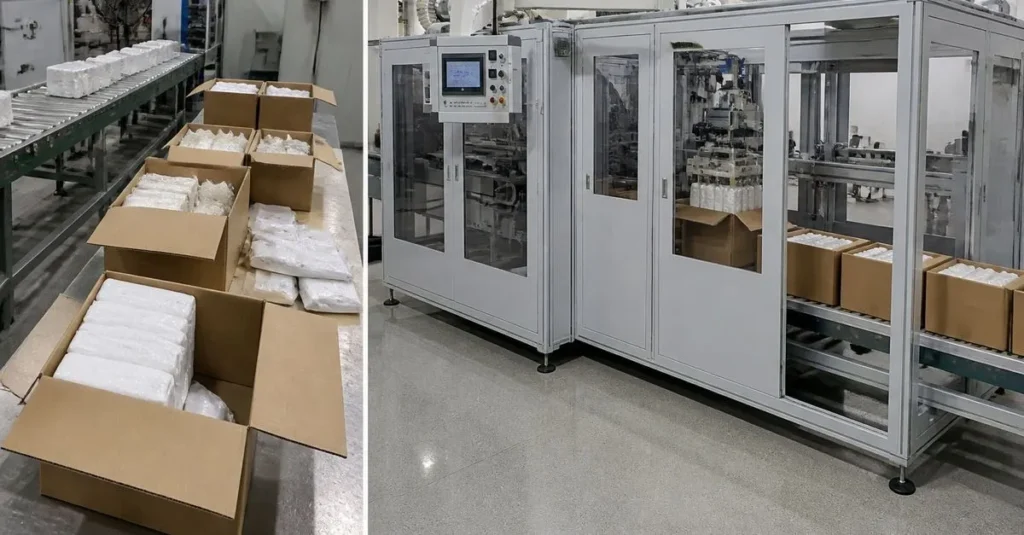
Automated packing lines for finished hygiene product packaging, compatible with sanitary napkin, diaper, and wet wipes production systems.
Learn MoreConclusion
The sanitary napkin market in Southeast Asia, the Middle East, and Sub-Saharan Africa is growing. The case for local production is getting stronger every year as import margins compress and local consumer demand increases.
The opportunity does not belong to the buyer who moves fastest. It belongs to the buyer who builds correctly — who confirms raw material compatibility before the machine ships, designs factory layout before the concrete is poured, trains operators before the line goes live, and treats the first 90 days of production as the real investment period.
A sanitary napkin machine that runs stably, shift after shift, with the materials available in your market and the team you can build — that is not a standard machine. That is a configured production system. The difference between those two things is the difference between a factory and a profitable business.
"If your line ran at 60 percent of its rated output for the first three months because of raw material compatibility issues that were discoverable before installation — what would that cost you in lost production and delayed market entry?"
FAQ
How do I confirm that my local raw materials are compatible with a Welldone sanitary napkin machine?
Share the specification sheets for your local raw materials — non-woven fabric, fluff pulp, hot melt adhesive, packaging film, and release paper — with our engineering team during the quotation phase. We review the specs against machine parameters and identify any adjustments needed before production begins. This process costs nothing and prevents the most common cause of first-month production problems.
What factory space do I need for a sanitary napkin production line?
A standard sanitary napkin line typically requires 400 to 600 square meters of production floor space, including the machine footprint, raw material storage adjacent to the line, finished product staging area, and operator work zones. We provide a factory layout drawing as part of the project planning process so you can confirm space requirements before committing to a facility.
How long does operator training take for a new sanitary napkin production team?
For a team with no prior hygiene product manufacturing experience, we recommend a minimum of 10 to 14 working days of hands-on training during installation and trial production. This covers machine structure, material feeding and tension management, sealing system adjustment, quality checkpoint procedures, size changeover, and basic maintenance.
Can Welldone machines produce multiple sanitary napkin sizes on the same line?
Yes. Our female care machines support size changeover for different product lengths, thicknesses, wing configurations, and packaging formats. Changeover procedures and parameter settings for each product size are documented during installation so your team can execute size changes without engineering support after the initial training period.
What after-sales support does Welldone provide after the machine is installed?
We provide ongoing technical support through video call, messaging, and remote diagnostics. For issues that cannot be resolved remotely, we dispatch engineers to the factory. We also supply spare parts and wearing parts recommendations based on your production volume and raw material type. Our goal is that your team manages daily operation independently — and knows exactly when and how to reach us when they cannot.
Planning a Sanitary Napkin Production Project?
Talk to us before you finalize your machine decision. We can help you confirm raw material compatibility, plan your factory layout, and build a production system that runs stably from day one.
Website: www.cnwelldone.com | Email: welldone@cnwelldone.com
Contact Welldone Today